


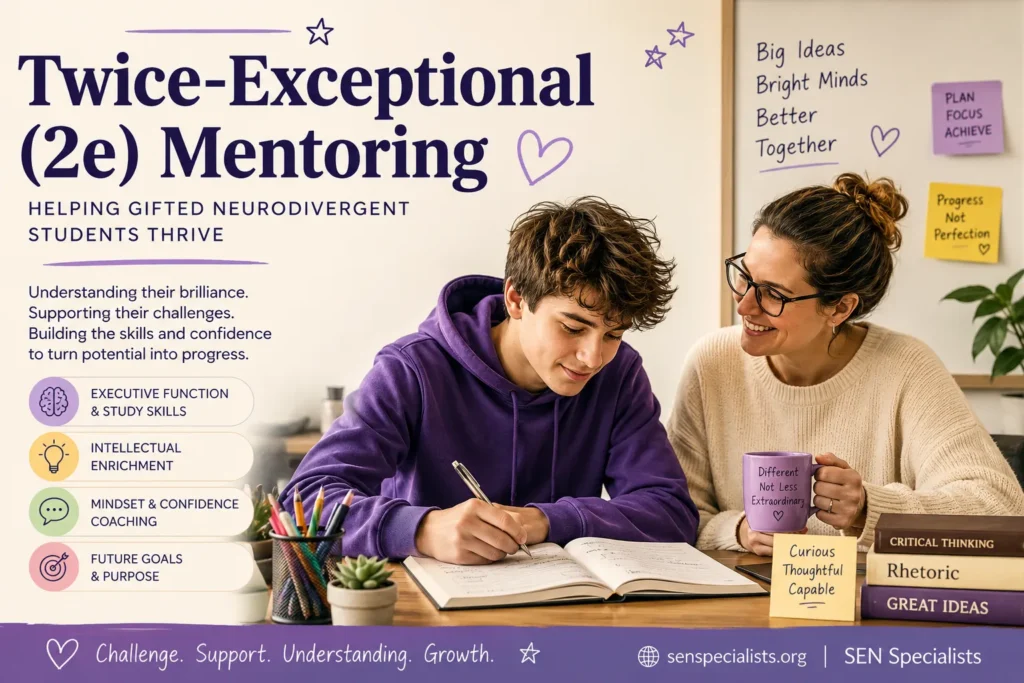
Some students have extraordinary intellectual ability, original ideas, intense curiosity and a deep capacity for learning—yet may also struggle with organisation, motivation, revision, emotional regulation, deadlines or confidence.
These are often twice-exceptional, or 2e, students: young people who are both gifted and neurodivergent. They may have ADHD, autism, dyslexia, dyspraxia or other differences in learning and processing, alongside high ability or exceptional potential.
At Senspcilaits, we believe these students do not need to be “fixed.” They need to be understood, challenged and given the right tools to turn potential into progress.
What Does Twice-Exceptional (2e) Mentoring Mean?
The term twice-exceptional describes students who are both:
- High ability, gifted or highly intellectually curious
- Neurodivergent or facing a learning difference, such as ADHD or autism
A 2e student may be capable of discussing complex philosophy, solving advanced problems or retaining huge amounts of information about a subject they love. At the same time, they may find it difficult to begin homework, plan an essay, revise consistently, manage time or demonstrate what they know in a conventional classroom.
This can be confusing for parents, teachers and the young person themselves. A child may appear “lazy,” “disorganised,” “unmotivated” or inconsistent—even when they are bright, capable and deeply engaged with the world.
The issue is usually not a lack of intelligence. It is often a mismatch between how they think and how education is delivered.
Why Gifted Neurodivergent Students Can Be Overlooked?
Many gifted neurodivergent students mask their difficulties because their intelligence helps them compensate. They may achieve acceptable grades without receiving the support they need, or they may underachieve because the school environment does not offer enough challenge, flexibility or understanding.
Some common experiences include:
- Being labelled as bright but “not applying themselves”
- Becoming bored with repetitive or shallow work
- Procrastinating until pressure becomes overwhelming
- Finding it hard to translate complex thoughts into written work
- Feeling perfectionistic or afraid of failure
- Having strong opinions but lacking confidence to express them
- Experiencing anxiety around school, revision or deadlines
- Being misunderstood as difficult when they are actually overstimulated, disengaged or overwhelmed
A student can be brilliant and still need support. High ability does not automatically provide executive-function skills, self-belief or effective study habits.
Teaching Students How to Think
Traditional tutoring often focuses on one subject, one exam or one assignment. While that can be valuable, many 2e students need something broader: a mentor who can help them understand how they learn, think, organise, communicate and grow.
This is where specialist mentoring can make a meaningful difference.
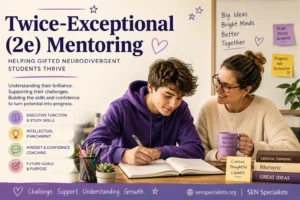
A 2e-focused mentoring approach may include:
- Executive-function coaching
- Revision and study techniques
- Motivation and mindset support
- Reading, discussion and general knowledge
- Debate, rhetoric and communication
- Philosophy, logic and critical thinking
- Career exploration and future planning
- Confidence-building and intellectual enrichment
The goal is not simply to help a student complete the next piece of homework. It is to help them build a sustainable relationship with learning—and with themselves.
Executive Function: Turning Ability Into Action
Executive functions are the mental skills that help us plan, start, organise, remember, prioritise and complete tasks. These can be particularly challenging for students with ADHD and autism, regardless of how intelligent they are.
A gifted student may understand the work perfectly but still struggle to:
- Start a task
- Break down an assignment
- Estimate how long work will take
- Keep track of deadlines
- Create an achievable revision plan
- Avoid distractions
- Finish work without perfectionism taking over
Specialist mentoring helps students develop practical systems that work for their brains. This might include visual planning, task breakdowns, body doubling, active recall, spaced repetition, checklists, accountability and interest-led study strategies.
The key is not forcing every student into the same method. It is helping them discover methods they can realistically use.
Intellectual Enrichment Matters Too
Gifted students need challenge as well as support.
For many neurodivergent young people, intellectual stimulation is not an “extra”; it is essential to engagement, confidence and motivation. Reading ambitious texts, exploring philosophy, debating ideas and developing broad general knowledge can give students a place where their curiosity is valued.
A more classical, well-rounded education can help students develop:
- Logic — evaluating arguments and thinking clearly
- Rhetoric — communicating ideas persuasively
- Philosophy — asking meaningful questions about life, ethics and society
- Debate — listening, reasoning and expressing views with confidence
- Reading and general knowledge — developing depth, context and intellectual independence
These skills are valuable not only for exams, but for university, careers, relationships and life.
Mindset Coaching for High-Potential Students
Many gifted students have a complicated relationship with achievement. Some feel intense pressure to live up to expectations. Others avoid trying because they fear that effort will reveal they are not as capable as people believe. Some have internalised years of criticism about being disorganised, distracted or “too much.”
Mindset coaching creates space to address confidence, resilience, motivation and self-understanding.
Students can learn to:
- Recognise their strengths without denying their challenges
- Recover from setbacks and mistakes
- Set meaningful, realistic goals
- Develop a healthier approach to perfectionism
- Understand motivation as something that can be supported, not simply demanded
- Build confidence in their voice, ideas and abilities
The aim is not to create a perfect student. It is to help a young person become more self-aware, capable and confident.
A Bespoke Approach for Exceptional Minds
Every twice-exceptional student is different. One may be an aspiring scientist who struggles to write essays. Another may be a gifted reader with ADHD who cannot begin revision without support. Another may be an autistic student with exceptional verbal reasoning who needs help with confidence, routines and navigating their future.
At Senspecialists, mentoring is designed around the individual. We combine academic support with executive-function strategies, intellectual challenge, coaching and encouragement.
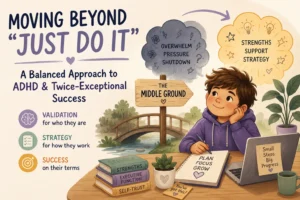
We help students move beyond the question, “Why can’t I just do it?” and towards a more powerful one:
“What do I need in order to thrive?”
For gifted neurodivergent students, the right mentor can provide both challenge and understanding: a place to develop practical skills, explore big ideas and build the confidence to use their abilities fully.