






As a parent, it can be heartbreaking to see your child’s potential so clearly while they struggle to show it in everyday school life.
Perhaps they are exceptionally bright, creative or verbally articulate. They may be able to talk deeply about science, politics, philosophy, history, gaming or a specialist interest. Yet when it comes to starting homework, planning revision, completing coursework or getting out of the door on time, everything can feel like a battle.
This is a familiar experience for families of gifted neurodivergent students, including many young people with ADHD, autism, dyslexia or other learning differences.
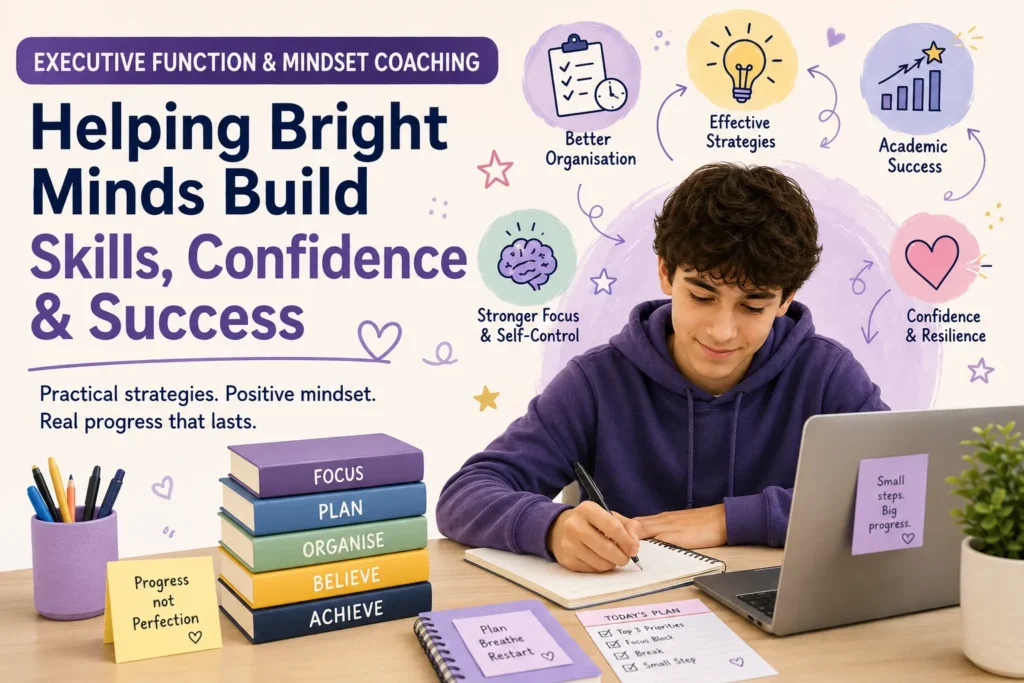
At SEN SPECIALISTS , executive function and mindset and motivation coaching is designed to help students understand how their minds work, develop practical learning systems and build the confidence to use their abilities fully.
What Is an Executive Function & Mindset Coach?
An Executive Function & Mindset Coach supports students with the skills that sit behind academic success and everyday independence.
Executive functioning includes the ability to:
- Start tasks
- Plan ahead
- Organise work and belongings
- Prioritise competing demands
- Manage time
- Remember instructions
- Regulate emotions
- Stay focused
- Complete tasks
- Recover after setbacks
Mindset and motivational coaching focuses on the beliefs, confidence and emotional patterns that can affect learning. It helps students move away from thoughts such as:
- “I am lazy.”
- “I always mess things up.”
- “There is no point trying.”
- “If it is not perfect, I cannot hand it in.”
- “Everyone else finds this easy.”
- “I am clever, so I should not need help.”
Instead, students learn to recognise their strengths, understand their challenges and build strategies that genuinely work for them.
The Parent Pain Points: “Why Can’t They Just Do It?”
Parents often come to us feeling exhausted, worried and frustrated not because they do not love or believe in their child, but because they have tried everything.
You may recognise some of these situations.
“My child is bright, but their grades do not reflect it.”
They may understand material in class, contribute brilliant ideas at home or have an extraordinary memory for subjects they love. But they forget deadlines, do not revise until the last minute, lose worksheets or fail to complete homework.
This gap between ability and attainment can be especially painful. It may lead others to say that a child is “not applying themselves,” when the real issue is often executive functioning not intelligence or effort.
“Every piece of homework becomes an argument.”
You ask them to begin. They say they will. Hours pass. They become distracted, overwhelmed, defensive or upset. You end up reminding, negotiating, monitoring or sitting beside them just to get started.
Over time, this can damage family relationships. Parents can find themselves forced into the role of teacher, project manager and emotional regulator rather than simply being a parent.
“They leave everything until the last minute.”
Some students appear unable to begin until panic creates enough urgency. Then they may produce impressive work in a very short period but at a significant emotional cost.
Last-minute success can mask the problem. The student may receive praise for the outcome while privately feeling anxious, ashamed and exhausted by the process.
“They are a perfectionist and refuse to hand work in.”
Gifted students can have very high internal standards. They may see every flaw in their work, feel that their thoughts are more sophisticated than they can express on paper, or fear that an imperfect piece of work will disappoint others.
Perfectionism can look like avoidance, procrastination or refusal. It is often driven by anxiety and a desire to protect a student’s identity as “the clever one.”
“They have lost their confidence.”
Repeated messages about being disorganised, forgetful, too intense, too sensitive or “not trying hard enough” can affect a young person deeply.
Even very able students can begin to believe they are failures. They may stop taking risks, disengage from school or hide their abilities to avoid pressure and disappointment.
Why Gifted and Neurodivergent Students Need a Different Approach?
A gifted neurodivergent student may need both challenge and support.
They may be capable of complex thinking while struggling with relatively simple organisational tasks. They may be highly articulate but unable to write an essay without scaffolding. They may be fascinated by big ideas but unable to revise from a conventional timetable.
This is not a contradiction. It is common among twice-exceptional, or 2e, students: young people who are both high ability and neurodivergent.
A one-size-fits-all approach often fails because it focuses only on what the student is not doing. Executive function and mindset coaching instead asks:
“What is getting in the way, and what support will help this student succeed?”
How Executive Function Coaching Helps?
Executive function coaching turns vague advice—such as “try harder,” “be more organised” or “just get on with it”—into practical, personalised strategies.
Depending on the student, support may include:
- Breaking large assignments into manageable first steps
- Creating realistic weekly routines
- Using visual planners, checklists and reminders
- Building an effective revision system
- Learning active recall and spaced repetition techniques
- Developing strategies to start difficult tasks
- Identifying distractions and designing a better study environment
- Building accountability without shame
- Managing deadlines and school workload
- Creating systems for bags, folders, notes and digital files
- Understanding how sleep, movement, interest and stress affect focus
The goal is not to make a student behave like everyone else. It is to help them develop an approach that works with their individual brain, strengths and needs.
Mindset and Motivational Coaching: Confidence, Motivation and Resilience
Academic skills matter, but students also need to believe that they can improve and cope with challenges.
Mindset coaching supports students to:
- Understand their own learning profile
- Identify strengths as well as areas of difficulty
- Separate self-worth from grades and productivity
- Develop healthier responses to mistakes
- Manage perfectionism and fear of failure
- Build self-advocacy skills
- Set meaningful goals
- Find motivation through interests, purpose and future ambitions
- Communicate their needs more confidently
- Devlop confidence and self esteem
- Ownership and personal responsibility
For many students, this is transformative. They stop seeing themselves as “lazy” or “broken” and start seeing themselves as capable learners who need the right tools.
Illustrative Case Study: The Bright Student Who Could Not Start
This is a composite example based on common student experiences; identifying details have been changed.
“Alex,” aged 14, was highly intelligent and fascinated by history, politics and debate. Teachers described him as insightful in class, but his homework was inconsistent and his revision rarely happened until the night before a test.
At home, starting schoolwork led to conflict. Alex would insist that he understood the work, become upset when reminded about it and then stay up late trying to finish everything at once.
Coaching began by exploring what happened before he avoided a task. Alex realised that he was not unwilling to work; he felt overwhelmed when he could not immediately see how to do the task perfectly.
Together, we developed a simple starting routine:
- Read the task aloud.
- Identify the smallest possible first action.
- Work for a short, defined period.
- Take a planned break.
- Review what was completed rather than focusing only on what remained.
Alex also learned to use active recall for revision rather than repeatedly rereading notes. Over time, he became more able to begin independently, his confidence improved and homework became less of a daily family conflict.
Illustrative Case Study: The High-Achiever Facing Burnout
This is a composite example based on common student experiences; identifying details have been changed.
“Amelia,” aged 16, was academically strong and deeply conscientious. She spent long hours on work but felt constantly behind. She rewrote notes repeatedly, struggled to decide what to revise and panicked when her work did not meet her own very high standards.
Her parents were concerned because she seemed exhausted and increasingly convinced that she was “failing,” despite achieving strong results.
Coaching focused on helping Amelia distinguish between productive effort and perfectionistic overworking. We created a prioritised revision plan, introduced time boundaries and used exam-style questions to give her clearer evidence of progress.
Mindset work helped Amelia challenge the belief that every task had to be flawless. She began to see that completing a good piece of work was often more valuable than endlessly pursuing an impossible standard of perfection.
The result was not simply improved study habits. Amelia began to feel more in control, more confident and less defined by academic pressure.
Illustrative Case Study: The Student Whose Interests Were Stronger Than School
This is a composite example based on common student experiences; identifying details have been changed.
“Sam,” aged 12, had an extraordinary knowledge of technology and engineering. He could spend hours researching subjects he loved, but he found routine school tasks difficult to begin and often said that lessons were boring or pointless.
His parents worried that he was becoming disengaged and that school was beginning to damage his confidence.
Coaching connected Sam’s interests with practical school goals. Revision became more active and challenge-based, with short tasks, visual systems and opportunities to explain ideas aloud. He was encouraged to see organisational skills not as pointless rules, but as tools that could help him pursue future ambitions.
By linking learning to his interests and giving him manageable systems, Sam became more willing to engage. His parents also had a clearer understanding of what support helped—and what made things harder.
A More Positive Way Forward for Families
Parents should not have to carry the full weight of managing revision, homework, deadlines and motivation at home.
A supportive mentor can provide a neutral, encouraging space where students can develop responsibility without feeling judged. This can reduce conflict, restore confidence and help a young person take greater ownership of their learning.
At Senspcilaits, we work with students as individuals. We recognise that intelligence does not remove the need for support, and that neurodivergence does not limit a young person’s potential.
Our approach combines:
- Executive function coaching
- Study skills and revision techniques
- Mindset and confidence coaching
- Intellectual enrichment
- Reading, philosophy and general knowledge
- Debate, critical thinking and communication
- Career and future-focused guidance
The aim is not merely better grades. It is to help students become more self-aware, motivated, organised and confident in their ability to shape their future.
Is Executive Function & Mindset Coaching Right for Your Child?
This approach may be especially helpful if your child is bright or highly able but struggles with organisation, motivation, revision, confidence, perfectionism or completing work independently.
They may have ADHD, autism or another neurodivergent profile or simply need a more personalised approach to learning and self-management.
Every student deserves to feel understood, challenged and supported.
At SEN SPECIALISTS , we help gifted and neurodivergent young people build the practical skills and inner confidence to thrive—not by changing who they are, but by helping them understand how to make their strengths work for them.