






When you search for a SEN tutor near me, the most useful filter is not proximity, it is specialism. A tutor who can genuinely support a child with ADHD, autism or dyslexia is defined by their training, their experience with that specific neurological profile, and a proven, adaptive teaching approach. These qualities have nothing to do with how close the tutor lives to your postcode.
Many families searching for SEN tuition near me start with location, only to find the right specialist was available online all along. At SEN Specialists, we work with families across the UK and internationally, connecting children with specialist tutors matched precisely to their needs. Starting your search with location as the primary filter risks excluding the best-suited support entirely.
Key takeaways
- Specialism beats proximity: Marketplaces commonly sort results by proximity, which does not indicate SEN expertise. SEN tutoring is not a commodity, and the tutor most suited to your child is rarely the closest one.
- Condition-specific experience matters: A tutor skilled with autistic learners may not understand the task-initiation and impulsivity barriers of ADHD. Match the tutor’s experience to your child’s specific profile.
- Credentials need verifying: There is no single mandatory qualification for private SEN tutors in the UK. Know what to request and how to interpret what you receive.
- Ask concrete questions: Vague assurances about patience and fun reveal nothing about specialist competence. Ask for specific examples and a structured trial session before committing.
- Online removes the constraint: Specialist SEN expertise is not evenly distributed across UK postcodes. Online delivery opens access to tutors who genuinely match your child’s profile.
Why “near me” is the wrong starting point for SEN support
What “local SEN tutor” usually means in practice
When you search for a local SEN tutor on a marketplace or directory, the results cover an enormous range of experience and training. A tutor who has worked with one or two children with mild learning differences is not equivalent to a practitioner with years of condition-specific practice. Local availability does not indicate depth of expertise, and it is easy to conflate accessibility with suitability. The fact that someone lives nearby tells you nothing about whether they understand demand avoidance, slow processing speed, or the communication differences that come with autism.
The gap between a generalist and a genuine specialist
A generalist tutor primarily teaches subject content. They explain concepts, adjust difficulty, and set practice tasks. A specialist SEN tutor does all of that, but also adapts the method, pace, structure and environment to the child’s individual learning profile. For a child with ADHD, that means visible timers, short work cycles, one instruction at a time, and planned movement breaks built into the session, not bolted on as an afterthought. For an autistic learner, it means a consistent beginning-to-end structure, literal and unambiguous instructions, advance warning of any change, and sensory considerations factored in before the session begins. Research and guidance indicate better outcomes when tuition is specialist and targeted, a point reinforced by the Evidence for Learning findings discussed below.
Finding a SEN tutor near me: what to actually prioritise
Matching the tutor’s specialism to your child’s specific profile
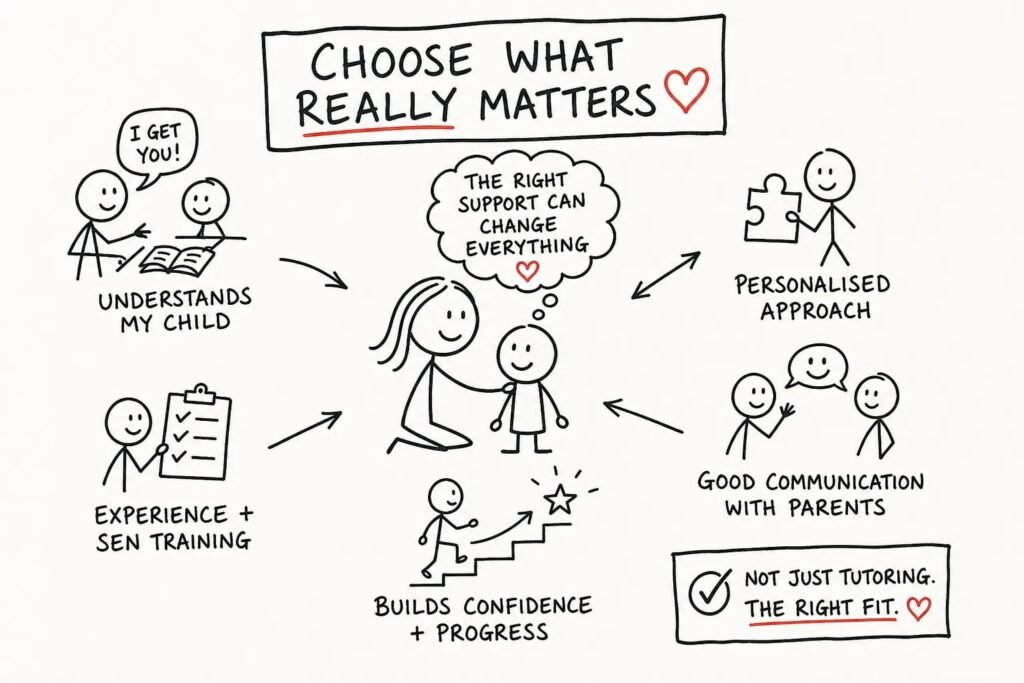
Condition-specific experience is not interchangeable. A tutor skilled with autistic learners may have no understanding of the impulsivity and task-initiation barriers central to ADHD. A dyslexia specialist may have little experience with PDA or demand avoidance. Before you search, identify your child’s primary barriers: attention, processing speed, communication, anxiety, reading fluency. Then seek a tutor whose training and experience maps directly onto those barriers. Ask for concrete examples of how they supported a learner with a matching profile, not broad reassurances.
Teaching approach and adaptability
A specialist SEN tutor does not deliver the same lesson structure to every child. Ask how they would chunk tasks into single achievable steps for a child who struggles with processing speed. Ask how they build independence rather than reliance on prompts. A well-qualified specialist treats regulation as part of the session, not an inconvenience that interrupts it. How a tutor responds to a moment of overwhelm, refusal or shutdown reveals more about their suitability than any CV entry.
How progress is defined and measured
Meaningful SEN tuition includes a baseline assessment, clearly stated short-term goals, and regular review. Ask what the tutor will measure beyond test scores: task initiation, confidence, independent strategy use, session engagement. According to Evidence for Learning, a review of 123 studies found that one-to-one tuition produces approximately five additional months of progress on average, but only when tuition is targeted, regularly monitored, and genuinely matched to the learner’s needs. A tutor who cannot explain how they will measure progress is not practising at a specialist level.
What qualifications and safeguarding checks should you request?
There is no single mandatory qualification or protected title for private SEN tutors in England, which means the responsibility for verifying suitability sits with you as the parent. QTS or a PGCE demonstrates formal teacher training but is not a legal requirement for private tutoring. For dyslexia and SpLD support, look for a Level 5 or Level 7 specialist teaching qualification, AMBDA membership, and an Assessment Practising Certificate if any formal assessment is involved.
For ADHD or autism, ask for specific CPD certificates relevant to the condition, alongside recent one-to-one experience with your child’s age group. SENDCO or NASENCO experience is valuable where your child has an EHCP and requires coordination with school staff. On safeguarding, for regular unsupervised work with a child in England or Wales, expect an Enhanced DBS check including Children’s Barred List information where eligible. Ask to see the original certificate, verify the tutor’s identity against it, and confirm whether they are registered with the DBS Update Service. Scotland uses PVG; Northern Ireland uses AccessNI. Request at least two recent references from child-related work. A reputable provider, whether individual or agency, should also explain their safeguarding procedures clearly, including how concerns are reported and what oversight applies during online sessions.
What questions should you ask before committing to a SEN tutor?
Ask the tutor to describe a concrete example of how they supported a learner with your child’s profile. Ask how they would break tasks into manageable steps for a child who struggles with processing speed or task initiation. Ask what they would do if your child became overwhelmed, refused to engage, or shut down during a session. Ask how they would connect their work to your child’s school support plan or EHCP, and how they report progress to parents. Strong answers are calm, specific, and child-centred. Vague responses such as “I keep things fun” or “I’m very patient” are not evidence of specialist competence.
A trial session should feel low-pressure and observational, not like an assessment. It should start with a predictable structure the child can see, include an accessible warm-up task, and show the tutor modelling a skill before asking the child to try it. Watch for how the tutor handles confusion or disengagement: do they wait, simplify, or push? After the session, ask what the tutor observed about your child’s strengths and barriers, and what their proposed focus for the first four to six sessions would be. A good trial ends with specific observations and a modest initial plan, not generic reassurance.
Online vs local SEN tutor near me: which is right for your child?
Specialist provision is unevenly distributed across UK postcodes. A parent in a rural area may have very limited options locally, while a parent in a major city may still find that the tutors available within reasonable distance are generalists. Proximity is a geographic accident. It has no bearing on whether a tutor can support a child with demand avoidance, sensory differences, or significant executive function difficulties.
Online delivery also removes travel time, can reduce sensory demands for some children, and allows sessions to begin and end without the transition stress that comes with going to a new location. The table below gives a practical overview of the main provider categories currently available to UK families.
| Provider type | Examples | Typical online rate | SEN verification | Best suited to |
|---|---|---|---|---|
| Managed home-tuition agency | Teachers To Your Home | Varies; request written quote including travel | Agency screening; confirm terms before booking | Families who want agency coordination for in-person tuition |
| Collaborative specialist team model | SEN Specialists | Contact for details | Hand-picked specialist team; learning designers, executive function coaches and progress reviewers behind every student | Families who need a joined-up, multidisciplinary approach rather than a single tutor |
What sets a genuinely specialist online service apart is not simply that it matches a child with a tutor and steps back. At SEN Specialists, every student is supported by a specialist tutor working alongside learning designers, executive function coaches, and progress reviewers. That level of multidisciplinary, joined-up support is not replicable by a locally sourced generalist, however convenient their location.
Making your decision: specialism first, location last
The right SEN tutor for your child is the one who understands their specific neurological profile, adapts their teaching accordingly, communicates clearly with you about progress, and maintains proper safeguarding standards. Location is a secondary consideration, and for many families who choose online SEN home tuition, it ceases to be a consideration at all.
Begin your search with specialism as the primary filter. Identify your child’s key barriers, seek a tutor with direct experience of those barriers, ask concrete questions in interview, and run a structured trial before committing to anything longer. Avoid being swayed by a long list of certificates without evidence of relevant, recent practice. The strongest candidates combine condition-specific training, a current safeguarding check, strong references, and demonstrable experience with a closely matching learning profile.
Speak to us about matching your child to the right specialist. We work with families across the UK and internationally to ensure every child is paired with the right support structure from the very first session, which is exactly what searching for a sen tutor near me should lead you to find.
Frequently asked questions
What does “SEN tutor near me” actually mean when I search online?
When you type “SEN tutor near me” or “special educational needs tutor near me” into a search engine, results are typically sorted by proximity. That is a practical starting point, but proximity alone says nothing about whether a tutor has condition-specific training, relevant experience, or appropriate safeguarding checks. Use the search to generate a list, then apply the criteria in this guide to filter it properly.
Is SEN private tuition near me always better than online?
Not necessarily. SEN private tuition near you may be appropriate if a local specialist with verified, condition-specific experience is available. However, specialist SEN expertise is unevenly distributed geographically. Online SEN tuition widens the pool considerably and, for many children, removes travel and transition stress that in-person sessions can introduce.
How do I find reliable SEN teaching support locally?
Start with specialist directories and agencies rather than general tutoring marketplaces. Ask for Enhanced DBS documentation, relevant qualifications (such as Level 5 or Level 7 SpLD), and references from families with a similar child profile. Whether you are looking for SEN teaching support locally or online, the verification steps remain the same.