SEN TUTORS : Special Education Needs Tutoring | GCSE - IGCSE Tuition |

Revision System Checklist for Parents of ADHD Students
Support GCSE & IGCSE revision for ADHD students with a proven system. A practical parent checklist covering environment, planning, active revision, and exam techniques.
James
A practical guide to support your child through GCSE & IGCSE revision
This checklist is designed to help parents of students with ADHD (diagnosed or undiagnosed) build a revision system that actually works. It focuses not just on what to revise, but on how to create the environment, structure, and habits that allow your child to perform consistently under exam conditions.
Tick each item as you put it in place. You do not need to do everything at once. Start with Section 1 and build from there.
Section 1: The Environment
Getting the physical and digital space right reduces friction before revision even begins.
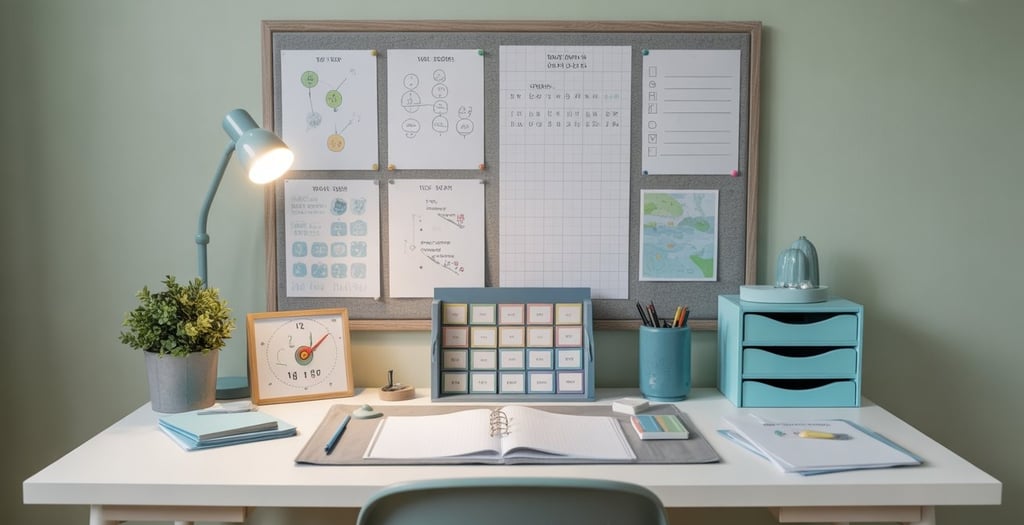
[ ] A dedicated, clutter-free revision space (the same place each time builds a habit cue).
[ ] Phone in another room or on Do Not Disturb during revision blocks.
[ ] Noise-cancelling headphones or low-fi background music if silence is distracting.
[ ] All revision materials (notes, past papers, flashcards) organised and within reach.
[ ] A visible clock or timer (not a phone) to manage time blocks.
[ ] Water and a snack available so there is no excuse to leave the desk.
Section 2: The Revision Plan
ADHD learners need a plan that is specific, visual, and broken into small steps.
[ ] A weekly timetable broken into 25 to 30 minute blocks (not 2-hour sessions).
[ ] Each block has one specific task (e.g. Active recall on Photosynthesis, not just Biology).
[ ] Subjects rotated across the week to maintain engagement and reduce boredom.
[ ] Harder subjects scheduled when energy is highest (usually morning or early afternoon).
[ ] Revision plan is visible on a whiteboard, wall chart, or printed sheet, not buried in a notebook.
[ ] Plan reviewed and adjusted weekly. Rigidity causes anxiety; flexibility builds resilience.
Section 3: Revision Techniques That Work for ADHD
Passive revision such as re-reading and highlighting is especially ineffective for ADHD learners. Use active methods.
[ ] Active recall: close the notes and write down everything remembered from memory (blurting).
[ ] Flashcards used for testing, not just making. The testing is where the learning happens.
[ ] Mind maps drawn from memory, not copied from notes.
[ ] Teach-back method: explain a concept out loud as if teaching someone else.
[ ] Spaced repetition: revisit topics at increasing intervals (Day 1, Day 3, Day 7, Day 14).
[ ] Short timed quizzes (10 minutes maximum) to build focus and simulate exam pressure.
Section 4: Past Papers and Exam Technique
Past papers are only useful when used strategically. Random practice without review builds bad habits.
[ ] Past papers attempted under timed conditions, not open-book.
[ ] Mark scheme reviewed after each paper to understand what examiners reward, not to memorise answers.
[ ] An error log kept: a simple notebook recording every lost mark and why.
[ ] Error log reviewed weekly and turned into targeted revision tasks.
[ ] Command words (Describe, Explain, Evaluate, Compare) practised separately until automatic.
[ ] Time allocation practised: student knows how many minutes per mark to spend.
[ ] Student practises triage: identifying easy marks first before tackling complex questions.
Section 5: Managing ADHD-Specific Challenges
These strategies directly address the executive functioning gaps most common in ADHD learners.
[ ] Use a visual timer so the student can see time passing. This reduces time-blindness.
[ ] Body doubling: revise alongside a parent, sibling, or friend (even silently) to improve focus.
[ ] Transition warnings: give a 5-minute warning before a revision block starts to reduce resistance.
[ ] Break tasks into the smallest possible steps. Opening the Maths folder is a valid first step.
[ ] Celebrate task completion, not just results. This builds a positive association with revision.
[ ] Avoid shame-based language around missed revision. Reset calmly and move forward.
[ ] Build in movement breaks (5 to 10 minutes) between revision blocks to reset attention.
[ ] Keep a brain dump notepad nearby. Write distracting thoughts down and return to revision.
Section 6: The Parent's Role
Your involvement matters, but the goal is to build independence, not dependence.
[ ] Check in briefly at the start of each revision block (What are you working on today?).
[ ] Avoid sitting in on sessions. Proximity can increase anxiety and reduce ownership.
[ ] Offer encouragement based on effort and process, not just grades.
[ ] Communicate regularly with the tutor or coach about what is and is not working at home.
[ ] Keep exam dates and deadlines visible in a shared family space.
[ ] Ensure sleep is protected. ADHD symptoms worsen significantly with poor sleep.
[ ] Monitor anxiety levels. If avoidance increases near exams, raise it with the tutor or coach early.
A Final Note
ADHD does not prevent exam success. Many of the most creative, lateral-thinking students we work with have ADHD. What they need is not more pressure or more content. They need a system that works with how their brain operates, and a mentor who understands the difference.
If you would like support building a personalised revision system for your child, or if you are unsure where the gaps are, we offer a diagnostic consultation to identify exactly where executive functioning is breaking down and how to address it.
About
Tailored educational support for unique learning needs in Singapore, UK, Malaysia, Philippines, Indonesia, Thailand, Laos, Cambodia & China.
EDUCATION FOR HEALTH UK (EFH) 2025. Copyright. All rights reserved.
Pages
Support Pages
What Next After GCSE and A Level or IB ?