






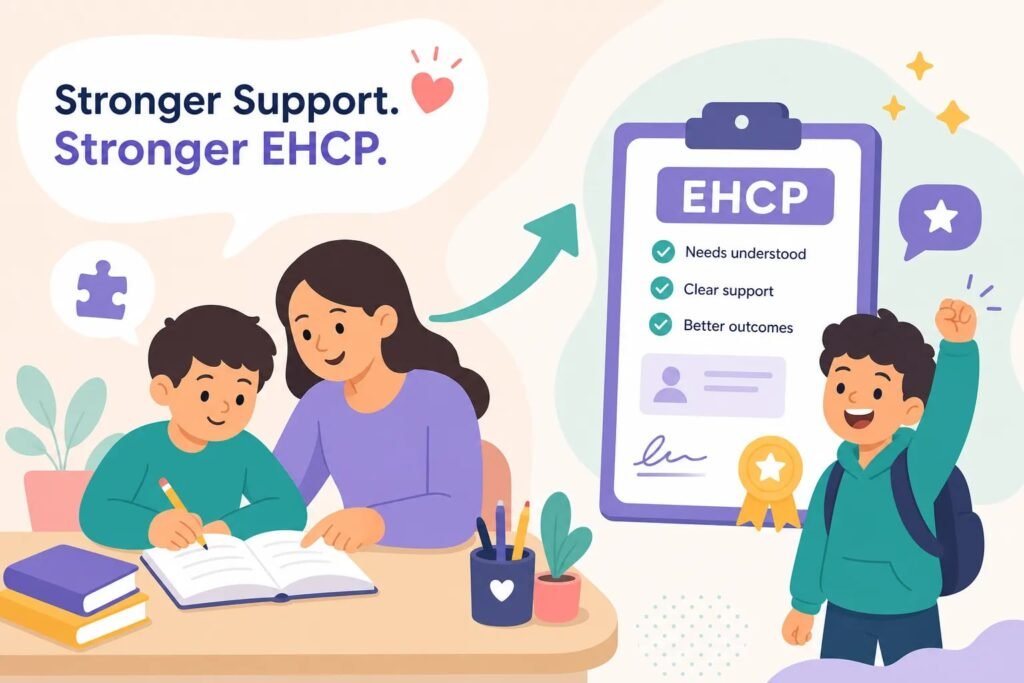
How does private SEN tutoring complement an EHCP in the UK? It’s a question many parents find themselves asking after the initial relief of securing a plan gives way to a more sobering reality. The EHCP arrives and it feels like a turning point. After months of assessments, meetings, and advocacy, your child finally has a legally binding plan. Then provision starts, and you notice something: the gaps are still there. Not because the plan is wrong, but because statutory provision was never designed to cover everything. Parents and practitioners consistently report shortfalls in specialist input, delays in delivery, and provision that simply doesn’t stretch far enough, even within well-written plans.
Private SEN tutoring doesn’t replace an EHCP. It works alongside it, addressing the specific areas that local authority-funded provision rarely has the time, flexibility, or specialist depth to reach. That’s not a criticism of EHCPs; it’s simply how they work in practice. The plan sets out what your child is entitled to. Private SEN tuition fills what the entitlement can’t quite reach.
If adding private support feels like admitting the plan has failed, reframe that instinct. Choosing to layer specialist 1:1 tuition on top of a funded package is a strategic decision, not a defeat. This article explains the gap areas, how to align private SEN tutoring with your child’s EHCP outcomes, how to build evidence your annual review panel will actually use, and what the funding realities look like. At SEN Specialists, this kind of EHCP-aligned work is precisely what we do.
What an EHCP actually delivers and where the gaps appear
It helps to understand what the two main sections of an EHCP are actually doing. Outcomes, set out in Section E, describe what your child is expected to achieve over time: “By the end of KS3, Jack will engage successfully in independent and supported learning” is a classic example. Provision, set out in Section F, describes exactly what must be delivered to help Jack get there: frequency, format, who delivers it, and in what setting.
Section F is typically written around a school or therapy environment. It specifies TA support, SALT sessions, small-group interventions, and adapted curriculum access. What it less commonly specifies is a specialist working 1:1 with the child on the underlying skills that make all of those other interventions more effective, particularly discrete support such as executive function coaching or confidence-building work.
Several areas are frequently absent from even well-written statutory packages: executive function development, bespoke academic learning design, and the kind of mentoring and confidence-building work that underpins genuine engagement. These are difficult to define as discrete interventions, which is partly why they don’t get costed into plans. That doesn’t make them optional. It just means someone else needs to provide them.
How private SEN tutoring complements an EHCP in the UK: three key gap areas
Executive function coaching
Executive function coaching is not academic tutoring. It targets the underlying systems that control how your child manages work: planning, task initiation, time management, working memory strategies, self-monitoring, and independent study habits. A TA can prompt a child to start a task. Executive function coaching teaches the child to initiate it themselves, and builds that skill deliberately over time.
Executive function difficulties are well documented in ADHD and are frequently reported in autistic learners too. Yet EHCPs rarely name executive function coaching as a funded intervention with its own discrete provision. At SEN Specialists, our collaborative model addresses this directly: a dedicated specialist tutor is supported behind the scenes by executive function specialists who shape the approach, rather than leaving a single tutor to cover everything at once.
Bespoke learning design
School-based EHCP provision typically works from existing systems: adapted worksheets, visual timetables, TA prompting scripts. These are valuable, but they are built around what already exists in the school, not around a single child’s precise profile. What specialist private tuition can offer is learning design built from scratch, resources, pacing, modality, scaffolding, and sequencing all determined by one child’s actual strengths and barriers.
This is the difference between adapting a system and designing one. At SEN Specialists, a dedicated learning design team works behind the scenes alongside each tutor, which means the session materials and approach evolve as the child does.
Confidence and mentoring alongside learning
Motivation, resilience, and self-belief are not optional extras for neurodivergent learners. They are prerequisites for engagement with every academic target in the EHCP. A child who has spent years feeling behind, confused, or out of place in a classroom needs something more than content delivery. This kind of mentoring is often not explicitly costed or specified within statutory provision, yet it is frequently the thing that unlocks everything else. In practice, this might look like a tutor spending the first ten minutes of each session helping a child decompress and reframe their thinking before any academic work begins, building the habit of self-regulation alongside the subject knowledge.
Aligning 1:1 SEN tuition with EHCP outcomes
Before the first session, share the full EHCP with your tutor. Specifically, ask them to read Sections B, E, and F. Section B describes your child’s needs. Section E sets out the outcomes. Section F specifies the provision. A specialist tutor who doesn’t ask to see the plan before working with your child is treating the tuition as generic. That matters.
The goal is for tuition to map directly to the outcomes already in the plan, not to run parallel to them in a well-meaning but disconnected way. EHCP outcomes are written for key stages, which makes them broad. A good specialist tutor takes an outcome like “Jack will engage successfully in independent and supported learning” and breaks it into specific, measurable session targets: breaking tasks into steps with decreasing prompts over eight weeks, for example, or self-checking work before handing it to an adult. These are SMART targets that sit beneath the longer-term outcome and feed back up into it.
Good 1:1 SEN tuition works within the assess, plan, do, review cycle, not just delivering content. The tutor assesses where the child is against the EHCP outcome and plans the approach accordingly. They deliver the session, then review whether it worked. That review loop drives the next adjustment, and it is what generates the kind of evidence your annual review can actually use.
Building evidence your child’s annual review will actually use
A session log is not a diary. It is a structured record that connects each session to the EHCP, and it should include: the date, the EHCP-linked objective worked on, the activities used, the level of support required, what the child did independently, and any barriers or adjustments made. Kept consistently, these logs form the backbone of a strong annual review submission.
Ask your tutor for termly written summaries tied to the plan’s outcomes, not just a verbal update after each session. Annual review panels respond to evidence showing impact over time, and a paper trail matters. Verbal reassurance, however well-intentioned, doesn’t hold up in a review meeting the way documentation does.
A strong evidence pack for tutoring for EHCP reviews includes:
- Baseline assessment data from the start of tuition
- Dated session logs linked to EHCP outcomes
- Work samples showing progress across the year
- Records of prompts removed as independence develops
- Brief pupil voice notes, your child’s account of their own progress
This kind of evidence achieves something beyond a record of attendance. It shows the review panel what worked, how your child responded, what was adjusted, and what is still needed. That is precisely the information that can strengthen the plan itself at review, whether that means amending provision or making the case for continued support.
Funding realities: what the local authority covers and what it doesn’t
Privately arranged tutoring is almost always a parental cost. That needs to be said plainly. Local authority funding for a private tutor applies only in specific circumstances: when tutoring is written as special educational provision into Section F of the plan, when an EOTAS (education otherwise than at school) package has been agreed, or when a personal budget or direct payment has been negotiated and the tutor is delivering exactly what the plan specifies.
Personal budgets are agreed at annual review and tied to specific provision in the plan. They are not a general top-up fund for additional support a parent has chosen independently. If you want a private tutor funded through a personal budget, the provision needs to be named in Section F first. That is worth pursuing at review if you have strong evidence that 1:1 specialist tuition is what your child needs and the statutory package isn’t providing it.
For most families, private tuition is a parental investment rather than an LA-funded entitlement. That is the honest answer. What reframes the decision is this: private SEN tuition, when properly briefed and aligned to the EHCP, can support individual progress in targeted areas more responsively than waiting for a review cycle to amend statutory provision, parents often report quicker improvements in the specific skills being worked on. And the evidence it generates strengthens that statutory plan over time. This is not money spent instead of using the EHCP, it is investment in the evidence base that makes the EHCP more effective.
Finding the right specialist: what to look for and what to ask
The non-negotiables are an enhanced DBS check, relevant SEND-specific training or experience, and demonstrable knowledge of your child’s specific profile, whether that is autism, ADHD, SpLD, or a combination. QTS is a useful signal of pedagogical grounding, but it is not always the deciding factor. Deep specialist experience with children who share your child’s profile matters more than a long list of generic certificates.
For complex profiles, ask specifically about executive function coaching, trauma-informed practice, and, if GCSEs are approaching, familiarity with exam access arrangements and the relevant UK awarding bodies. A good SEN tutor for a secondary-age student is not just a subject specialist. They understand how SEND intersects with assessment, access arrangements, and the pressure of high-stakes exams.
When you find a prospective tutor, give them the EHCP before the first session and ask them directly: which outcomes in this plan will you actively target, and how will you report progress against them? Agree on a reporting format from the outset. A specialist who welcomes that conversation is a specialist worth working with. One who finds it unnecessary or burdensome tells you something important.
At SEN Specialists, every student is supported through a collaborative team model: a specialist tutor working 1:1, backed by learning designers, executive function mentors, and progress reviewers working behind the scenes. The service is structured from the start to complement a child’s EHC plan, targeting the outcomes already in the document while filling the gaps that statutory provision cannot reach. If you’d like to find out how that works for your child’s specific situation, get in touch with our team to arrange an initial consultation.
An EHCP is a foundation, not a ceiling
Understanding how private SEN tutoring complements an EHCP in the UK means recognising what each part of the picture is doing. The plan sets out what your child is entitled to. Private SEN tuition, briefed properly and aligned to those outcomes, fills what the entitlement can’t quite reach, building the independent learning skills, the tailored academic approach, and the self-belief that makes all of it stick.
Choosing to add specialist private support is not an admission that the EHCP has failed. It is a deliberate, evidence-backed decision to give your child more of what actually works. The two sit together, and when the private tuition is documented properly, it feeds directly back into strengthening the statutory plan at annual review.
Start with the EHCP in front of you. In your first conversation with any prospective specialist, open the plan together and ask them how they would approach the outcomes in Section E. The right specialist will not just answer the question. They will ask follow-up questions of their own.