






Someone tells you your child needs a tutor. Maybe it’s their teacher, maybe it’s a SENCO, maybe it’s just a quiet voice in your own head after watching your bright, curious child come home defeated again. So you search online, find a handful of profiles, and realise very quickly that you have absolutely no idea what you’re looking for. A tutor is a tutor, right?
Not quite. Deciding between a SEN tutor vs regular tutor can feel genuinely overwhelming, and that gap, the one between a mainstream tutor and a specialist SEN tutor, is where a lot of families end up spending money, time and hope without getting the results their child actually needs. Finding the right SEN tutoring services in the UK is genuinely confusing for families navigating it for the first time. Terms overlap, profiles look similar, and almost everyone claims to be “experienced with additional needs.” At SEN Specialists, we hear this from families regularly: they’ve tried tutoring before, it didn’t work, and they’re not sure why. More often than not, the answer comes down to fit, specifically, whether the tutor understood how their child’s brain works, not just the subject they were struggling with.
This article is a practical guide to help you cut through the noise. By the end, you’ll know the real differences in training and method between a SEN tutor vs regular tutor, when each type of support is the right choice, and what questions to ask before you book anyone. There’s a checklist at the end. Use it.
SEN tutor vs regular tutor: training and qualifications
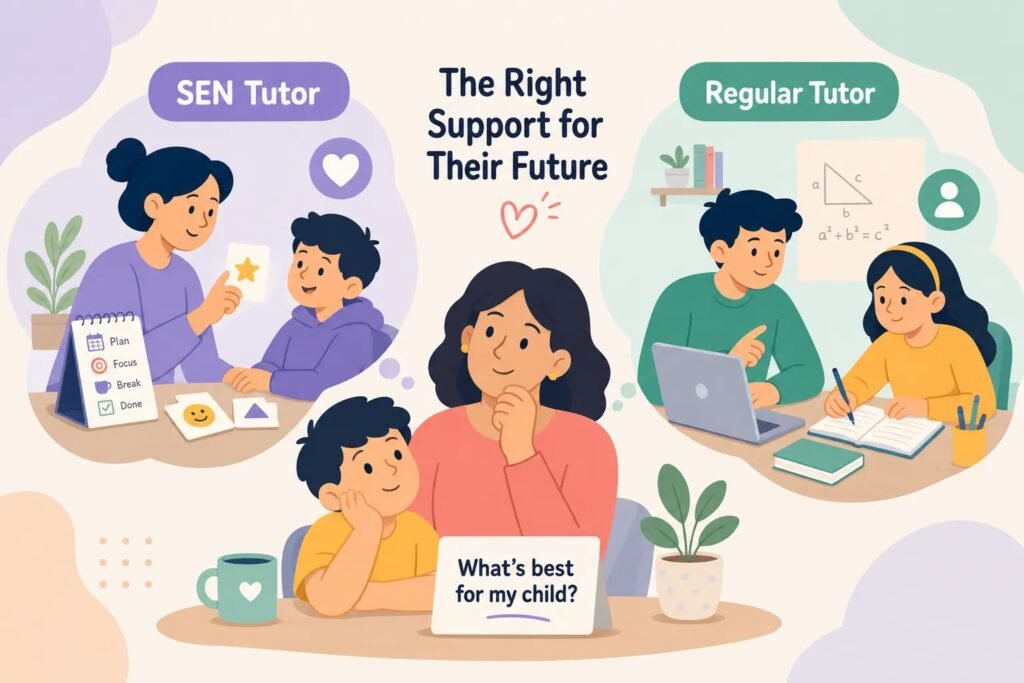
Most mainstream tutors are assessed on subject knowledge, academic degree, and general teaching experience. Some hold QTS (Qualified Teacher Status) and have strong classroom backgrounds, which makes them well-suited to children who learn in a fairly straightforward way and need curriculum consolidation or targeted exam preparation. That is perfectly appropriate support for the right child.
A specialist SEN tutor, or special educational needs tutor, brings something different. The distinguishing factors are:
SEND qualifications to look for
Condition-specific continuing professional development covering areas like ADHD, autism, dyslexia and social, emotional and mental health needs; Level 4 or Level 5 SEND qualifications; and demonstrable experience adapting teaching for complex and varied learning profiles. An enhanced DBS check is standard practice. Many specialist providers also expect a working familiarity with the SEND Code of Practice and EHCP processes, as well as the ability to communicate meaningfully with schools and other professionals, though these are expectations of good practice rather than legal requirements for tutors specifically.
Why QTS alone isn’t enough
Here’s the thing worth holding onto: QTS alone does not make someone a specialist in SEN. A teacher with twenty years in a mainstream classroom may be excellent at their job and still be entirely unprepared for a child whose anxiety spikes mid-session, whose working memory gaps make standard explanations fall flat, or who needs a completely different entry point to the same concept. The real qualifier is not what someone knows, it’s how they’ve been trained to respond when a child’s needs show up in the room.
How teaching actually looks different in the session
Take the same maths topic, say fractions, and put it in front of two different tutors with two very different children. A mainstream tutor prepares a clear lesson plan, explains the concept, works through examples, and sets practice questions. For many children, that works beautifully. For a child with ADHD, the attention has gone by question two. For an autistic learner who needs to understand the sequence before engaging with any single step, jumping straight in feels disorienting. The lesson isn’t wrong; it’s just not designed for how that child’s brain processes information.
A specialist SEN tutor approaches the same session differently from the outset. For a child with ADHD, tasks are chunked into short, timed bursts with movement breaks built in. Instructions are given one at a time. Positive reinforcement is deliberate and specific.
For an autistic learner, the session opens with a visual timetable so they know exactly what’s coming. Routines are consistent. Sensory considerations are built into the environment, even in an online space. For a child with dyslexia, the explanation is multisensory: visual, auditory and kinaesthetic approaches layered together, not because it’s a nice idea, but because decades of structured literacy research, including work on approaches such as Orton-Gillingham, consistently shows better outcomes for dyslexic learners.
The resources a specialist SEN tutor uses aren’t add-ons or nice extras. They are the default: visual schedules, mind maps, text-to-speech tools, colour-coded materials, differentiated worksheets designed around the child’s specific profile. A mainstream tutor may use some of these occasionally, but the depth of understanding about why a particular tool works for a particular neurological profile is what makes the difference.
When a mainstream tutor is the right fit, and when it isn’t
Being honest here matters, because specialist SEN support isn’t the answer for every child. A mainstream tutor is genuinely a strong choice when a student needs focused revision without significant barriers to accessing information, or when they’re mildly behind in a subject but engage reliably in structured sessions and retain what they’re taught. Think of a Year 10 student who finds algebra confusing but is motivated, stays focused, and just needs someone to explain the method clearly. A good mainstream tutor will do an excellent job.
The picture changes when a child consistently shuts down under pressure, cannot sustain attention across a standard session length, or has sensory sensitivities that affect how they engage. It also changes when learning itself has started to feel threatening rather than merely difficult. These are the signals that something more specific is needed, the kind of one-to-one SEN tuition that is built around how that particular child processes the world.
Critically, a formal diagnosis is not a prerequisite for specialist support. Many children benefit enormously from SEN-informed tuition before any diagnosis is confirmed, or without one at all. The barrier to specialist support should be the child’s needs, not the paperwork.
The support structure behind the sessions
Even a highly qualified learning support tutor, working alone, faces real constraints. Within a single session, one person is planning, teaching, observing, assessing and adapting simultaneously. When a child’s needs are complex or evolving, executive function difficulties, anxiety, curriculum gaps and confidence all at once, that is a significant amount to carry in one pair of hands, however skilled.
This is precisely why the model at SEN Specialists is built differently. Each student has a specialist tutor as their primary point of contact, but behind every session is a coordinated team working on their behalf. This includes learning designers building bespoke resources, executive function specialists informing how sessions are structured, and progress reviewers ensuring the approach adapts as the child grows. This team-based model is central to how SEN Specialists operates.
Many tutoring agencies match a student with a tutor and largely step back. Independent freelance tutors, however experienced, often work alone. At SEN Specialists, the team works together, out of sight of the student, so that what shows up in each session is genuinely joined-up thinking rather than the output of a single pair of hands.
What specialist SEN support costs in the UK
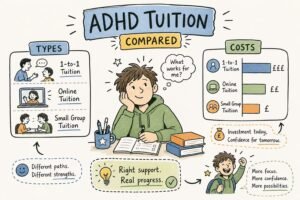
Mainstream tutors in the UK typically charge between £30 and £50 per hour, rising to £60 or more for experienced teachers and GCSE specialists. Specialist SEN tutors on the open market generally sit at £45 to £70 per hour, with structured specialist providers, where a team rather than a solo tutor is delivering the support, often at £80 to £120 per hour or above. Online SEN tuition is usually at the lower end of those ranges, and for many neurodivergent learners, a familiar, lower-distraction home environment can make online sessions easier to access and more comfortable to engage with.
Cost is worth thinking about carefully. Evidence from the Education Endowment Foundation and related research suggests that targeted specialist interventions for pupils with SEND can produce, on average, around five months’ additional progress compared with standard teaching, though outcomes vary depending on the nature of the intervention and the child’s individual profile. That’s a meaningful potential gain. The more useful comparison, though, is this: a child who has had two or three terms of well-meaning but mismatched tutoring has spent money and, more importantly, time, without moving forward. Specialist support that is well-targeted from the beginning can deliver faster progress; evidence on long-term durability is more limited, but the difference between matched and mismatched support tends to show up quickly. The upfront cost reflects the depth of expertise and preparation behind each session, not simply the hour in front of the screen.
Questions to ask before you book any tutor
Whether you’re exploring the open market or considering a structured service, these questions should form the backbone of any initial consultation. A specialist will answer them with specifics, not generalities.
- What direct experience do you have with my child’s specific need, such as ADHD, autism or dyslexia? Ask for a concrete example of a student with similar challenges and how they were supported.
- Can you walk me through how you would adapt a session if my child is dysregulated, anxious or having a particularly difficult day?
- How do you measure progress and communicate it to parents? Look for a structured answer: check-ins, reviews, written updates, not just “we chat at the end of the session.”
- Are you willing to liaise with the school or other professionals such as an OT, SALT or CAMHS worker if relevant?
- What happens if your approach isn’t working after a few sessions? A good specialist has a clear answer to this.
Pay attention to how a tutor answers, not just what they say. Strong answers name real conditions, describe actual strategies, and demonstrate genuine curiosity about your child as an individual. Red flags include vague reassurances like “I’m great with all kinds of learners,” reluctance to collaborate with schools, or no clear process for monitoring progress. Any tutor worth working with should welcome these questions rather than deflect them.
Choosing well is choosing differently
Choosing a tutor is one of the most consequential decisions a family makes for a child who is already finding things hard. It deserves more than a quick profile scan and a gut feeling. When it comes to SEN tutor vs regular tutor, the core distinction is straightforward: a mainstream tutor delivers subject knowledge, and a specialist SEN tutor delivers subject knowledge alongside a deep, practical understanding of how to make it accessible to a child whose brain works differently.
Take the five questions above into any initial conversation, whether you’re approaching an independent tutor, a tutoring platform, or a specialist SEN tutoring service. They’ll tell you quickly whether you’re talking to someone who truly understands your child’s profile or someone who is hoping their general experience will be enough. For many children with SEN, “hoping” isn’t enough.
If you’d like to talk through what your child needs and whether our team at SEN Specialists might be the right fit, get in touch. We’re happy to have an honest conversation before you commit to anything. That’s always the right place to start.