






Demand for ADHD tuition in the UK appears to have grown considerably in recent years, yet “specialist” has become a word applied with very little consistency. A parent searching online will find dozens of tutors on marketplace platforms listing ADHD experience in their profiles, alongside dedicated SEN agencies, clinic-linked programmes, and everything in between. The language across all of them is often identical, and that’s the problem. This ADHD tuition comparison guide exists precisely because, when every provider describes themselves in the same way, meaningful comparison becomes almost impossible.
What follows is a working framework for making that comparison. It covers qualifications, teaching approach, session design, realistic cost ranges and the specific questions to ask before you commit to anything. Throughout, we reference the model used at SEN Specialists as a concrete example of what genuinely specialist provision looks like structurally, because the structural differences matter more than most parents realise.
What actually separates a specialist ADHD tutor from a generalist
Many parents may reasonably assume that if a tutor lists ADHD on their profile, they’ve had meaningful training in it. That assumption is worth challenging. There’s no regulated qualification specifically for ADHD tuition in the UK, which means the label can be applied to someone who completed a brief awareness course just as easily as to someone who holds a postgraduate SpLD qualification and spent years working in a specialist SEN setting. The label applies to both with equal legitimacy, and that ambiguity is the core problem parents face when comparing providers.
The qualifications gap parents rarely check
Genuine SEN-informed qualifications include QTS with substantial specialist experience, Level 5 or Level 7 SpLD diplomas, SENCo experience, or AMBDA and PATOSS membership for SpLD-focused work. These credentials indicate a depth of training that a short awareness course simply doesn’t replicate. When speaking to a prospective tutor, the most revealing question isn’t “do you have ADHD experience?” but “what formal SEN training have you undertaken, and where?” The answer will tell you a great deal about whether their specialism has depth or is simply a marketing term.
Teaching approach vs. subject delivery
Subject expertise and SEN pedagogy are two entirely separate things. A highly qualified maths tutor can still deliver sessions in a way that’s fundamentally misaligned with how ADHD learners process information and re-engage after losing focus. ADHD-informed teaching looks different in practice: sessions are chunked into shorter bursts, routines are consistent and previewed, feedback is immediate rather than deferred to the end, and the environment is deliberately low in distraction. Without those structural features, even excellent subject knowledge produces limited results for many ADHD learners.
The collaborative team model vs. one tutor working alone
Many freelance tutors operate without institutional oversight, pairing with a student and largely working independently. At SEN Specialists, the model is deliberately different. Every student has a specialist tutor, but that tutor is supported by a broader team working behind the scenes: learning designers who shape the session structure, executive function mentors who inform the approach, and progress reviewers who monitor whether the support is working. For complex ADHD learners, this matters practically. It means the session approach is designed collectively rather than improvised by a single practitioner, and it means someone is actively adjusting the support when it isn’t working. Fewer providers describe this level of team-based learning design in their public materials, which makes it a meaningful structural difference rather than a marketing distinction.
ADHD tuition comparison: the main provider types in the UK
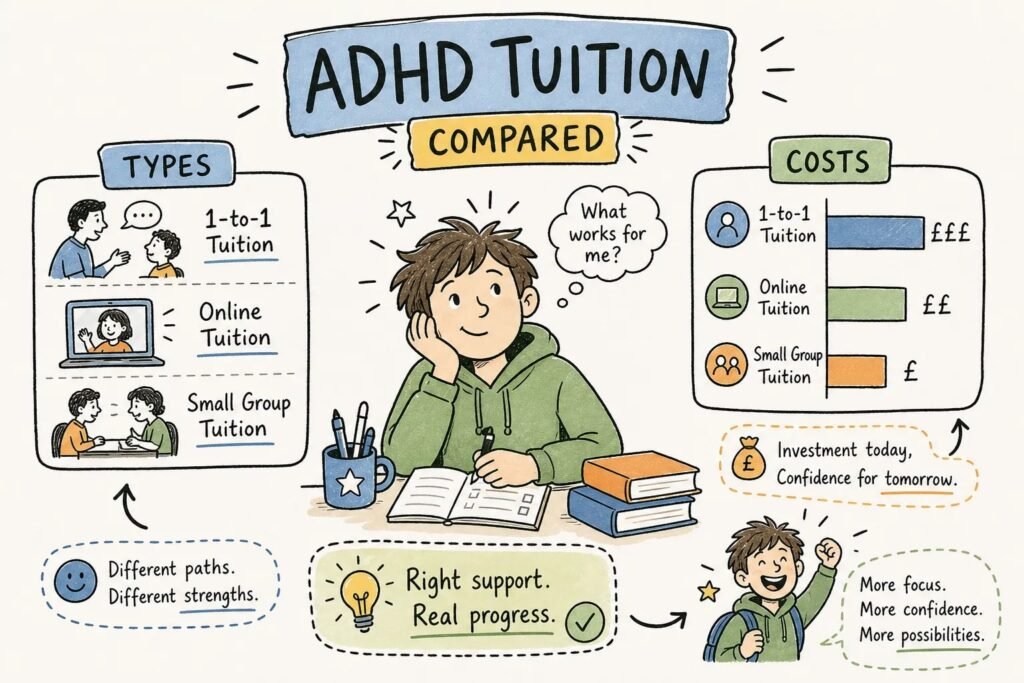
Before you start comparing specific providers, it helps to understand the three broad categories they fall into. Each carries a different accountability structure, cost profile and quality ceiling.
Tutor marketplaces and freelance tutors
Platforms that connect parents with individual tutors represent the largest and most accessible part of the private tuition for ADHD market. Tutors on these platforms self-describe their specialisms, and the platform typically doesn’t vet SEN qualifications in any depth. This isn’t a criticism of every individual tutor listed there, genuinely skilled practitioners do operate this way. The issue is that the platform offers no guarantee of quality, no supervision structure and no learning design oversight. Hourly rates at this end of the market tend to be lower, which reflects that reduced accountability layer rather than a simple cost saving.
Specialist SEN tuition agencies
SEN agencies recruit tutors specifically for SEN work and usually have a more structured intake process. Rates are higher, typically reflecting tutor vetting, matching procedures and some degree of organisational oversight. The critical question to ask any agency is whether they provide genuine learning design and progress monitoring alongside the tutor match, or whether the “agency” is essentially a directory with a billing function. Some offer a robust team model; others don’t, and the difference isn’t obvious from their website.
Clinic-linked and programme-based provision
Some ADHD clinics or educational psychology practices include tuition as part of a broader support package. These tend to be the most expensive tier, often involve waiting periods, and their scope overlaps with diagnostic or therapeutic work rather than straightforward academic tuition. For families whose child needs both clinical support and academic help, there can be real value in this integration. For families primarily seeking focused academic progress, it may be more than is needed.
ADHD tuition comparison: costs and what they actually reflect
Pricing in this market varies sharply, and without context the range is confusing. Here is a practical breakdown of what the current UK market looks like.
Hourly rates by provider type
At the lower end, marketplace-based tutors who list ADHD support average around £28 to £40 per hour. Specialist SEN agency tutors commonly sit between £90 and £120 per hour, with rates at the higher end of that range reflecting deeper qualification requirements, structured oversight and tutor supervision. Premium and London-based specialist providers can reach £120 to £150 per hour, with some top-end listings above that. These differences reflect qualification depth, session preparation time, the supervision structure behind the tutor and, in some cases, the learning design work that happens between sessions. An hour of contact time is not the same thing across price points.
Package pricing and what it should include
Some specialist providers structure their offering as a programme rather than hourly pay-as-you-go. When evaluating a package, look for whether it includes an initial assessment, bespoke learning design, regular progress reviews and tutor oversight, or whether it simply bundles a fixed number of sessions at a slight discount. A block of identical sessions without adaptation is a bulk purchase, not a structured programme. The former is worth paying more for; the latter isn’t.
When EHCP funding or other support applies
Families with an EHCP may be able to access private specialist tuition through a personal budget or direct payment, provided the tuition is specified in Section F of the plan and the local authority agrees to the arrangement. This is worth raising directly with your school SENCO or SEN officer, particularly at annual review. It’s also worth noting that a child doesn’t need an EHCP to access specialist private tuition; many families fund it independently while also pursuing statutory support.
Does one-to-one ADHD tuition actually work?
The Education Endowment Foundation rates one-to-one tuition as high impact for moderate cost, estimating around five months’ additional progress on average across more than a hundred studies. That’s a compelling headline, but it comes with an important caveat: the evidence base is not ADHD-specific. Research summarised by the ADD Resource Center found that where attention difficulties approached ADHD-level severity, the benefits of standard tutoring were reduced. For children with both reading difficulties and significant attention problems, some analyses found no measurable benefit from tutoring at all.
That doesn’t mean tuition doesn’t work for ADHD learners, it means the quality and design of delivery matters far more for this group than for neurotypical students. Drawing on both the EEF findings and the ADD Resource Center research, the structural features associated with better outcomes include shorter sessions of 30 to 45 minutes and explicit routine and predictability. Equally important are immediate feedback rather than end-of-session review, reduced cognitive load through chunking and visual scaffolds, and executive function support built into the session rather than treated as a separate task. A tutor who delivers these features consistently will produce meaningfully different outcomes than a subject-qualified tutor of equivalent experience who doesn’t.
Questions to ask before you book any ADHD tuition provider
Most initial calls with tuition providers follow a predictable script: the provider describes their service, you describe your child, and you leave without a clear basis for comparison. The questions below shift that dynamic. They’re not a trick, they simply reveal whether a provider actually does what they say they do.
About qualifications and direct ADHD experience
Ask what formal SEN training they hold beyond classroom experience, and specifically whether that training included ADHD-informed pedagogy rather than general SEN awareness. Ask them to describe how their approach to a session with an ADHD learner differs from a standard lesson. Then ask what they do when a student disengages partway through. The answer to that last question is particularly telling. A generalist will often describe waiting it out or redirecting to the same task; an experienced ADHD specialist will describe a planned recovery routine built into the session design from the start.
About session design and ongoing adaptation
Ask how long sessions run, how frequently they recommend meeting, and what the structure of a typical session looks like. Ask how they adapt when a child is having a particularly dysregulated day, and whether each session is planned in advance or whether the tutor improvises based on what the student wants to cover. There’s nothing inherently wrong with flexibility, but a session without a design is not specialist provision. For ADHD learners specifically, the predictability of structure is itself a therapeutic feature of the session.
About progress monitoring and communication with you
Ask how and how often they report back to you. Ask whether anyone else is involved in your child’s support, and how the tutor interacts with school, the SENCO or other providers. This is where the difference between an isolated freelance tutor and a supported team model becomes most visible. A sole practitioner will typically report to you directly and informally. A collaborative model, like the one used at SEN Specialists, involves structured progress reviews, coordinated adjustments and a team that holds the wider picture of your child’s development, not just their performance in the last session.
Choosing with a clearer lens
The ADHD tuition market is unregulated, and self-described specialism is common. A high star rating on a marketplace, a persuasive website or a prominent position in a search result are not reliable indicators of genuine specialist provision. This ADHD tuition comparison framework gives you something more useful: a way to assess qualifications, teaching approach, session structure and the presence of real oversight, regardless of how a provider presents themselves. Use it to shortlist providers and ask the right questions before you commit.
At SEN Specialists, we built our model around the gaps that most of the market leaves unfilled. A collaborative team supports every student, genuine learning design shapes each programme between sessions, and progress monitoring is structured to evolve as each child develops. If you’d like to explore what that looks like for your child, get in touch with our team to arrange an initial consultation.
The right provider isn’t always the most visible one, and knowing what to look for is the most useful starting point you can have.