






Picture this: your child sits at the kitchen table, homework sheet in front of them, pencil in hand. Twenty minutes pass. Nothing gets written. You ask if they need help. They say no. Another five minutes. Still nothing. It looks, from the outside, like defiance or disinterest. But something far more specific is happening, and it has a name that most parents have never been properly introduced to: executive function in ADHD.
Once you understand what executive function is, and why ADHD disrupts it so reliably, everything changes. The blank page makes sense. The forgotten PE kit makes sense. The meltdown over an unexpected change of plan makes sense. Studies now consistently show that up to 89% of children with ADHD have impairment in at least one executive function domain. That is not a small finding. It reframes the entire conversation about what your child needs and, most importantly, what good specialist support should actually look like.
What executive function actually is (and why ADHD disrupts it)
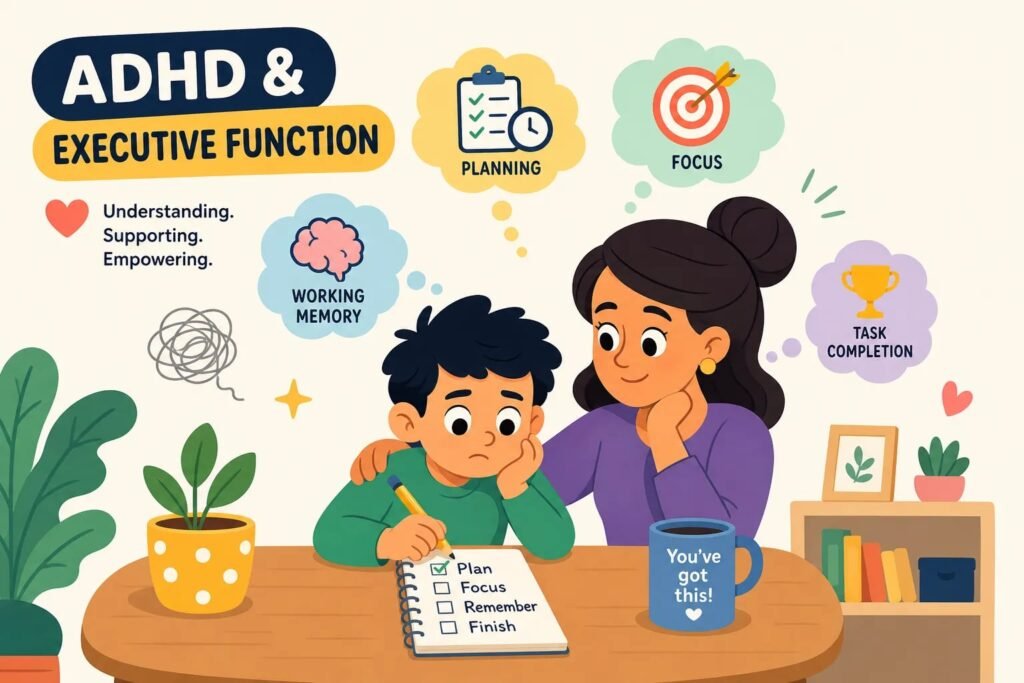
Think of executive function as the brain’s internal management system: the set of mental processes that allow us to plan ahead, start tasks, hold information in mind while we use it, regulate emotions, and shift between demands without falling apart. If the brain were an airport, executive function would be the air traffic controller, keeping every incoming and outgoing flight coordinated. Without it, you don’t just get a bit of turbulence. You get chaos on the runway.
ADHD and executive function are deeply intertwined. ADHD is not primarily a disorder of attention in the traditional sense, it is a disorder of self-regulation and executive control. That distinction matters enormously, because it changes where you look for solutions. Neuroimaging studies consistently report differences in prefrontal development and connectivity in children with ADHD: the prefrontal cortex, which governs these executive skills, tends to mature more slowly and connect less efficiently with other brain regions. This is a neurological reality, not a character flaw, and not a failure of parenting. When older research using narrower assessment methods found executive dysfunction in only 33, 50% of children with ADHD, it painted an incomplete picture. Studies using more cognitively informed measures consistently find that figure closer to 89%. Your child is navigating a daily mountain that most people around them simply cannot see.
The EF domains most affected in children with ADHD
Working memory: why “forgetting everything” is not selective
Working memory is the most consistently impaired executive function domain in ADHD, with some studies indicating that as many as 75, 85% of children with ADHD are affected to some degree. It is the system that holds information in mind long enough to do something useful with it. When a parent says “get your bag, find your reading book, and come to the table,” a child with poor working memory may lose that sequence before they reach the door. Not because they weren’t listening. Because their working memory couldn’t hold all three instructions at once.
The academic consequences run deep. Following multi-step problems in maths, tracking a narrative across a long reading comprehension passage, holding an essay structure in mind while writing: all of these depend heavily on working memory. Research suggests that ADHD status combined with working memory difficulties accounts for around 25% of the variance in reading comprehension performance, and the effect is strongest when tasks place the heaviest demands on that system. Over time, repeated difficulty with these tasks chips away at confidence, not just performance.
Inhibition, planning and emotional regulation
Inhibitory control, the ability to pause before acting, is impaired in roughly 21, 46% of children with ADHD, depending on the measures used. Poor planning means a deadline feels abstract until the evening before it arrives. Weak cognitive flexibility means switching between tasks, or accepting an unexpected change to the day, can trigger a response that looks wildly disproportionate from the outside but is entirely consistent with what is happening internally.
Emotional regulation deserves particular attention here, because it sits within the executive function framework yet is rarely discussed in school SEND conversations. The link with working memory is especially clear: stronger working memory predicts better emotion regulation, and weaker working memory predicts more dysregulation. Parents are often told their child is “overly sensitive” or “reactive” without anyone connecting that back to the same neurological roots as the forgotten homework and the half-finished tasks. These are not separate problems. They share the same source.
How these challenges shift as your child grows
The primary school years: when organisation starts to fracture
At primary school age, executive function deficits show up in tangible ways: lost PE kits, classwork that never gets finished, homework completed but never handed in, and meltdowns triggered by a substitute teacher or a changed timetable. The academic content is still manageable for many children at this stage, but the organisational layer begins pulling things apart. This is often the point at which parents sense something is different, though schools may label it as immaturity or lack of effort.
Evidence-based support at this stage centres on structure: highly predictable routines, visual checklists, immediate and specific reinforcement, and multi-step instructions broken down and delivered one piece at a time. The goal is to reduce the demand on the child’s internal management system by building external structure around them, rather than simply expecting them to try harder.
Adolescence: when the independence gap widens
The shift to secondary school dramatically increases executive demand. Students must manage multiple subjects, teachers, deadlines and social dynamics simultaneously, with far less adult scaffolding. Longitudinal research confirms that executive function deficits in ADHD often persist into adolescence and can grow more pronounced at this stage, because the gap between what is expected and what the young person can manage independently becomes wider, even as expectations for self-sufficiency rise sharply.
Time estimation becomes a significant problem. Revision planning falls apart. Emotional regulation difficulties begin to affect friendships and self-esteem alongside academic performance. The recommended approach at this stage shifts from providing external structure toward explicitly teaching self-management systems: planners, digital reminders, coaching in self-monitoring, and support with breaking long-term goals into concrete steps. These skills do not develop naturally by waiting; they need to be taught deliberately.
Practical strategies parents can use at home right now
Externalise everything and reduce the memory load
The most consistently supported principle in ADHD and executive function research is simple: stop relying on the child’s internal management system and externalise it instead. Take tasks, reminders and plans out of their head and put them somewhere visible. A visual daily routine on the wall instead of a verbal reminder each morning. A whiteboard in the kitchen showing the three things that need to happen before school. A homework checklist broken into steps, not just outcomes.
Timers deserve a special mention. Starting a task is often the highest executive function barrier of all, and a visible countdown removes the vagueness that makes beginning feel so hard. This is not a workaround or a crutch. Reviews of external prompting strategies consistently support timers and visible countdowns as effective accommodations for children with ADHD, because they reduce demand on an overtaxed system. None of this requires a clinical background. It requires consistency and a willingness to scaffold rather than expect independence before the brain is ready for it.
Chunking tasks and building routines that stick
Instead of “do your homework,” the instruction becomes a sequence of single steps, tackled one at a time with a check-in between each. Set up a homework routine with the same cues, the same location, and the same order every evening. Predictability reduces the executive function demand of getting started, because the brain doesn’t have to decide what happens next; it already knows.
Brief, regular check-ins work better than one long supervision session. Five minutes at the start to clarify the first step, a brief touch-point in the middle, and a short review at the end. These are low-effort for a parent but high-impact for a child whose executive function system struggles to maintain momentum without external support.
Why specialist support needs to treat EF as core, not optional
Most tutoring approaches focus on content: fill the gap in maths, cover the next unit of English, prepare for the upcoming assessment. For a child with ADHD, this misses the fundamental problem. If a child cannot initiate a task, hold a method in working memory, or regulate the frustration that comes with getting something wrong, content delivery alone will not produce lasting progress. Reviews of intervention research support multicomponent approaches that combine skill-building with environmental scaffolding. Isolated subject support, delivered without EF awareness, tends to produce weaker and less durable results.
Parents often sense this before they have the language for it. They’ve tried tutors before. Something didn’t stick. Understanding executive function in ADHD explains why, and it raises the bar for what specialist support should actually include.
At SEN Specialists, executive function coaching is built into the tuition model from the outset, rather than being an optional add-on parents have to request separately. Specialist tutors work one-to-one with students, while executive function specialists shape how sessions are structured, how tasks are presented, and how independence is developed gradually over time. A student who struggles with task initiation isn’t simply given more encouragement; the session itself is designed with that barrier in mind. Working memory challenges, planning difficulties and emotional regulation needs are actively accounted for in every learning interaction, not noted at intake and quietly set aside.
For families who want academic progress and executive function development to happen together rather than in parallel, this integrated approach reflects how the two are connected in practice. If that sounds like what your child needs, the team at SEN Specialists is happy to talk through how they work and whether it might be the right fit.
The child at the kitchen table deserves better answers
That child sitting in front of the blank page isn’t struggling because they don’t care or can’t learn. They are navigating a real neurological difference that affects the very systems needed to get started, stay organised, and manage the emotions that come with finding things hard. That deserves understanding, not just sympathy.
It is worth holding onto a few things. Executive function deficits in ADHD are common, measurable and often developmentally persistent, for many children and adolescents, they do not simply resolve with age or effort alone, though the picture varies between individuals. Practical strategies at home, applied consistently, can make a meaningful difference to daily functioning and confidence. And specialist support works best when it treats executive function coaching as central to the learning process, not as a nice-to-have footnote.
Trust your instinct that your child needs a different kind of support. Understanding ADHD and executive function is the first, most important step in finding it.