






You’ve bought the planner. You’ve built the reward chart. You’ve colour-coded the timetable, set the reminders, and had the encouraging conversation about trying harder. And yet, by Tuesday, the system has collapsed and your child is melting down over an assignment they forgot was due tomorrow. If that sounds familiar, you’re not alone. In our work at SEN Specialists, we hear this weekly from families who’ve tried every planner, chart and reward system going.
The missing piece is almost always this: executive dysfunction in ADHD is not primarily a motivation problem. It has a neurobiological basis. The part of the brain responsible for planning, starting tasks, managing time, holding instructions in mind, and regulating emotion works differently in ADHD brains, though motivation, mood, sleep and situational factors can also play a role. That’s not a metaphor. It’s brain architecture. That distinction changes everything about how you approach support.
This guide explains how to improve ADHD executive dysfunction in practical, evidence-informed steps. It covers what executive dysfunction actually is, why generic advice so often falls short, and which strategies genuinely move the needle for children and teenagers with ADHD. No false promises, just a practical framework you can start using this week, though measurable improvement is usually gradual and worth tracking over time.
What executive dysfunction in ADHD actually means
Executive function is the set of cognitive processes that manage everything else: planning, organising, starting tasks, estimating time, holding information in working memory, and regulating emotional responses. Think of it as the brain’s management system. When it works smoothly, a person can sit down, decide what to do first, resist distractions, and see a task through to completion. When it doesn’t, the struggle is real even when the knowledge and the intention are both present.
ADHD doesn’t just affect focus. It disrupts this entire management system. A common example: your teenager knows the essay is due on Friday. They know exactly what it’s about. They sit down at the desk, open the laptop, and then nothing happens. Not because they don’t care, but because the internal signal to initiate the task simply doesn’t fire reliably. That’s executive dysfunction playing out in real time, and it looks, from the outside, like indifference.
These difficulties translate directly into school struggles: missing deadlines, forgetting instructions mid-task, being unable to break a large project into steps, and shutting down emotionally when work feels overwhelming. Teachers and parents often read this as laziness or defiance, a misread that is damaging, because the shame it produces can compound the very difficulties it’s meant to address. The goal isn’t to try harder; it’s to build smarter external systems.
How to improve ADHD executive dysfunction: setting realistic expectations
No strategy, app, or coaching programme eliminates executive dysfunction. What they do is build external structure around a struggling internal system, reducing the cognitive load enough that the young person can function more reliably. Progress is gradual and uneven. There will be good weeks and difficult ones, and neither is the full picture.
A more useful definition of success: tasks are started more reliably, homework sessions are less frequently driven by crisis, and the young person recovers faster after a setback rather than spiralling. Perfect consistency is not the goal. Functional improvement, over time, is.
The most common reason strategies stop working isn’t that they’re bad strategies. It’s that they’re too complex, or they require executive function to maintain. A colour-coded planner system with five categories and a weekly review process sounds excellent. For a young person with executive dysfunction, maintaining it becomes another overwhelming task. Start with one tool and one routine. Expand only when the first is stable. Research and clinical guidance on executive skills interventions consistently point to simple, visible systems as far more maintainable than complex ones, and that principle alone prevents many strategy collapses.
Practical strategies for task initiation and planning
The “next physical action” method
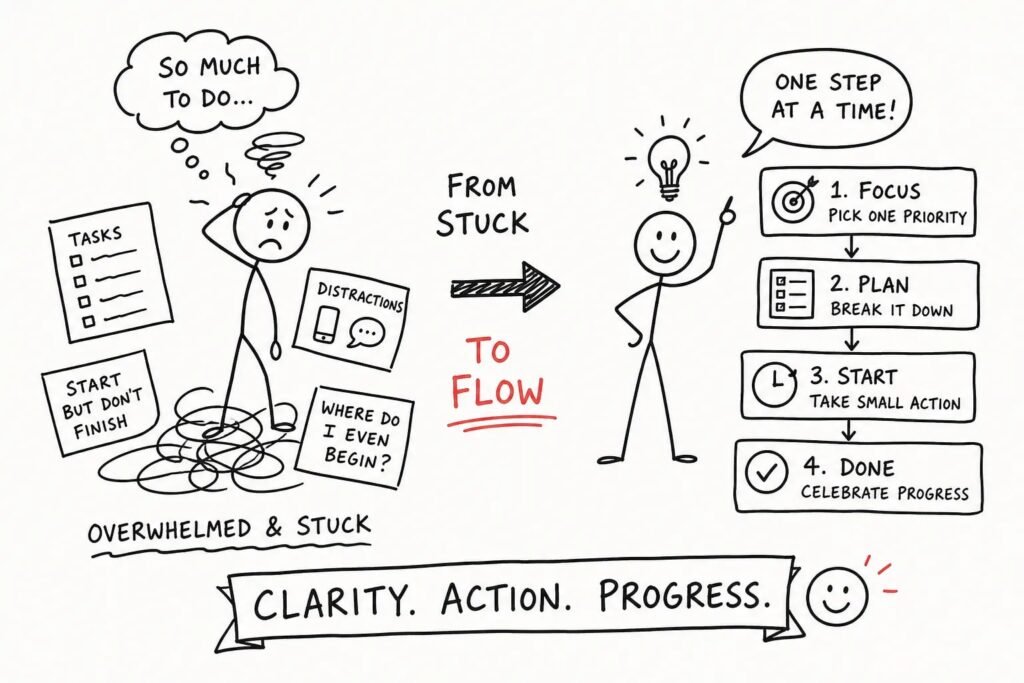
Vague tasks don’t get started. “Do the essay” is not an action; it’s a category. Replace it with one concrete, observable step that takes under two minutes: “Open the document and write one sentence.” That’s it. The goal is to remove the decision-making barrier at the moment of initiation, which is precisely when executive function is most unreliable. This is one of the most practical ADHD task initiation strategies available, because it costs nothing and can be applied immediately.
For younger children, a parent can help by sitting alongside and naming the first step together, not the whole task. For teenagers, writing the first action at the bottom of a to-do list item before closing the notebook can make the difference between starting tomorrow and not. If a step can’t be described as a physical action you could observe someone doing, it’s still too broad.
Routine anchors and the daily three priorities
Routine anchoring attaches a new behaviour to something that already happens: after breakfast, after arriving home from school, after brushing teeth. This removes the need to remember to do the thing, because the trigger is already built into the day. It also reduces decision fatigue, which is a significant drain on an already stretched executive system.
Pair this with a “three priorities” approach: each day, identify one main task and two smaller ones, each with a named first action. Write them somewhere visible, not buried in an app. This provides just enough structure without tipping into overwhelm. It’s a small system, which is exactly why it works.
Body doubling and accountability
Body doubling means working alongside another person, whether in the same room or on a video call. The external presence provides a structure that the ADHD brain’s internal system struggles to generate alone. Research on body doubling is still developing and relies largely on self-report data; one notable survey of around 220 neurodivergent respondents found that the large majority reported being more likely to complete tasks when someone else was present, though this was a self-selected sample rather than a controlled trial. Even so, anecdotal evidence is strong and the approach costs nothing to try.
Practical options include working at the kitchen table with a parent nearby, joining a virtual study session with a friend, or using one of the many online co-working platforms. In practice, most people find that both individuals working quietly works best, the goal is presence, not supervision, though individual responses do vary. Body doubling is a low-cost ADHD organisation strategy with promising user reports, and it can be worth trialling to see whether it helps your child specifically.
Tools to improve ADHD executive dysfunction, working memory and organisation
The most effective setup is simple: one calendar, one task manager, and one visual timer. Google Calendar with two reminders per event (one for preparation, one for the task itself) handles appointments and deadlines. Todoist or TickTick captures tasks and converts them into named, actionable steps. Tiimo or Forest provides a visual, concrete sense of time for focus sessions. Some NHS ADHD services, for example East London NHS Foundation Trust and Leicestershire Partnership NHS Trust, reference these types of tools as useful organisational aids for working memory support in ADHD, though recommendations vary by service.
The reason one system beats several competing ones is straightforward: a young person with executive dysfunction can’t reliably maintain multiple platforms. Switching between systems requires the very planning and decision-making that is already impaired. Pick one tool per function and stay with it.
Physical aids often complement or outperform apps alone, particularly for visibility and low friction. A wall planner in a high-traffic area, a whiteboard for the week’s top tasks, a fixed “home” for keys, medication and school bags, and a printed checklist for the morning routine are all visible without unlocking a phone. Visibility is the mechanism. An aid that can be seen passively, without any intentional action, is harder to ignore than a notification that gets dismissed.
Tangible, low-friction tools deserve serious consideration alongside digital ones. NHS material and studies on ADHD time management techniques note that visible, environmental cues are frequently more effective than hidden app prompts for this group.
Lifestyle factors that genuinely support executive function
Regular aerobic exercise produces short-term improvements in attention and inhibitory control. Even a 10 to 20-minute session before sitting down to study can help. For teenagers, this doesn’t need to mean a gym session: cycling to school, a brisk walk around the block before opening a textbook, or a short dance workout all count. The evidence for exercise isn’t as strong as for medication, but it’s consistent and the barrier to trying it is low.
Sleep is arguably the highest-yield lifestyle factor for executive functioning. Poor or inconsistent sleep worsens working memory, emotional regulation and planning independently of ADHD. The most impactful steps are straightforward: a consistent wake time every day, exposure to natural light in the morning, and reduced screen stimulation in the hour before bed. Circadian delay is common in young people with ADHD, so if sleep problems are significant, it’s worth discussing this with a clinician rather than assuming better sleep hygiene alone will resolve it.
Regular, balanced meals matter because skipped meals and energy crashes worsen symptoms that are already challenging. That’s the honest, practical case for nutrition. Supplements and elimination diets have much weaker evidence and should only be explored with a clinician. Frame lifestyle changes honestly: they support the system, but they don’t replace structured strategies or, where appropriate, medication.
When self-help strategies aren’t enough
Some signs are worth paying attention to: school refusal, complete task avoidance across all settings, severe emotional dysregulation, or a pattern of trying and abandoning systems repeatedly. These suggest that the young person needs more than a better planner. Anxiety, depression, sleep disorders and unaddressed learning differences can all worsen executive dysfunction significantly, and each may need its own assessment.
Structured executive function coaching looks different from a one-off session of tips. It’s an ongoing, adaptive process where strategies are practised, reviewed and refined alongside real schoolwork, adjusted as the young person’s needs evolve. This is the model we follow at SEN Specialists. Rather than offering executive function support as an add-on, our specialist tutors work alongside learning designers and coaches behind the scenes, weaving planning, task initiation and organisation support directly into every session, an integrated approach that generic tutoring is not designed to replicate.
When you’re looking for a provider, prioritise one that works collaboratively rather than in isolation, and that adapts its approach as your child develops. A young person’s needs at the start of support rarely look the same six months in, and the right team adjusts with them.
Putting it all together
Learning how to improve ADHD-related executive dysfunction is not about fixing a character flaw. It’s about building the right external structure and practising it consistently, with the right support around you. The brain architecture doesn’t change overnight, but functioning can improve meaningfully when the environment is designed to compensate for what the internal system struggles to provide.
The most actionable takeaways from this guide: choose one external tool and use it consistently. Build one routine anchor. Name one physical first action for every task. Hold realistic expectations about what progress looks like, and measure it by function and recovery, not perfection.
If the strategies here feel like the right starting point but your child needs more consistent, specialist support woven into their learning, it’s worth exploring what structured executive function coaching embedded in specialist tutoring looks like in practice. Get in touch with our team at SEN Specialists to find out how we support young people with ADHD to build the skills and confidence they need, one session at a time.