






GCSE years arrive fast. If you’re searching for special educational needs tutors for GCSE, you’ve likely already watched your child struggle through mainstream classroom support, and the idea of finding someone who can actually help feels both urgent and exhausting. For some families, general tutoring hasn’t bridged the gap. The classroom hasn’t met their child’s needs. And now the exams are real.
Many parents reach a point where they realise the problem was never content. Their child understands more than their marks suggest. The barrier is how the content is delivered, practised and assessed, and that is a fundamentally different problem requiring a different solution. Finding the right specialist SEN tutor for GCSE means finding someone who understands that distinction and knows what to do about it. Before you book anything, it’s worth knowing what good looks like. This article covers what to look for, where to search, what to pay, and how exam support actually works.
Why specialist SEN tuition for GCSEs is not the same as mainstream tutoring
A standard GCSE tutor teaches content. A specialist SEN tutor for GCSE changes how content is delivered, paced and practised to match a learner’s neurological profile. That’s not a subtle difference. It’s the whole thing. Where mainstream tutoring can fall short for SEND students is that it often replicates the same classroom methods that haven’t worked, more of the same, delivered more slowly, producing more of the same results.
SEN-informed pedagogy looks quite specific in practice. It means breaking tasks into smaller, clearly sequenced steps and reducing cognitive load so that working memory isn’t overwhelmed before a student has a chance to demonstrate what they know. It also means using retrieval practice, multimodal explanations, graphic organisers and explicit exam-technique instruction adapted for slower processing speed or executive function difficulties. None of this is adaptation for its own sake. It’s about removing barriers to demonstrating knowledge that’s already there.
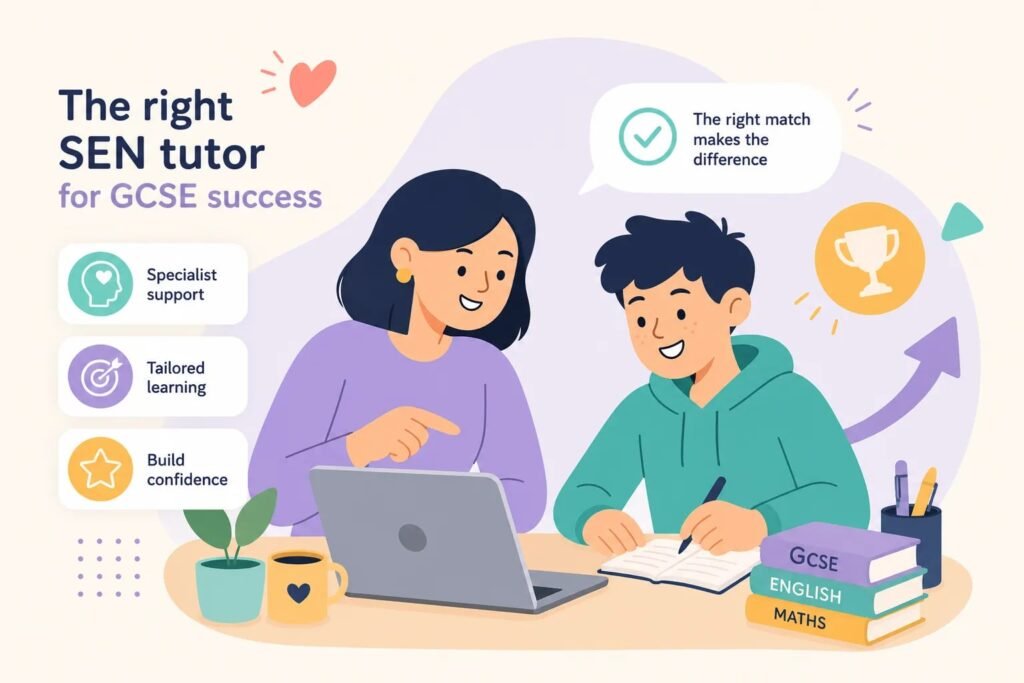
The most effective specialist SEN support is rarely delivered by one person working alone. Many leading specialist providers pair each student with a dedicated tutor backed by learning designers, executive function coaches and progress reviewers working collaboratively. That is a fundamentally different model from a general agency that matches a child with a tutor and steps back. This kind of collaborative approach means the teaching evolves as the student’s needs, confidence and independence develop, something a single tutor, however experienced, may not be able to achieve alone.
SEN Specialists is built on exactly this model: structured, specialist academic tuition designed around how neurodivergent learners actually think and work, with a multidisciplinary team supporting every student’s progress.
Finding special educational needs tutors for GCSE: what qualifications and experience to look for
Credentials matter, but context matters more. A long list of letters after a name means nothing without recent, relevant experience with your child’s specific profile. The right combination is strong subject knowledge, meaningful SEN training, and a clear explanation of how lessons will actually be adapted. A fourth quality worth looking for: genuine familiarity with GCSE exam boards and the demands of timed, high-stakes assessment.
Credentials that signal genuine SEN expertise
QTS combined with secondary SEN experience is a solid starting point, but probe what that SEN experience actually involved. A SENCO background is valuable because it means the tutor understands assess-plan-do-review processes, EHCP frameworks, exam access arrangements and communication with schools. For dyslexia specifically, a Level 5 or Level 7 SpLD qualification matters, but check whether it included supervised teaching with secondary-age learners. AMBDA and BDA Approved Teacher Status are recognised specialist dyslexia credentials: AMBDA supports formal diagnostic assessment as well as teaching, while ATS confirms BDA-recognised teaching competence. For high-demand GCSE subjects, examiner experience on the relevant exam board is worth asking about directly.
Questions to ask before committing
Ask which specific GCSE subjects and exam boards the tutor has taught recently. Ask how they would adapt sessions for your child’s profile. Ask how they measure progress and how they communicate with the school SENCO. Confirm they hold a current DBS check and professional insurance. These aren’t intrusive questions; they’re basic filters. A tutor worth hiring will answer them clearly and without hesitation. If the explanation of how lessons will be adapted is vague, that tells you something important before you’ve spent a penny.
Where to find reputable SEN GCSE tutors in the UK
Most parents start with a general tutoring marketplace because it’s the obvious first step. The problem is that on general platforms, the burden of evaluating SEN suitability falls entirely on you. Profiles can claim SEN experience without verification, and there’s no oversight of whether the match is genuinely appropriate for your child.
Specialist agencies vet SEN GCSE tutors specifically for experience and oversee the matching process more rigorously, typically basing placements on an initial consultation and a careful assessment of your child’s strengths, barriers and goals. SEN Specialists operates this way, as do other specialist providers in the UK. General marketplaces can still be useful when you need a particular GCSE subject and are confident in evaluating SEN suitability yourself, but for complex or primary SEN needs, a specialist provider is almost always the better starting point.
Before booking a first session anywhere, verify credentials rather than accepting them at face value. Ask for references from families with a similar child profile. Check that the provider has clear safeguarding policies and DBS arrangements. Ask what happens if the match doesn’t work. A reputable specialist service welcomes these questions rather than deflecting them.
Understanding the cost of specialist SEN GCSE tuition
Rates reflect real specialism, not marketing. For a qualified SEN tutor for GCSE, expect to pay between £30 and £45 per hour. An experienced QTS or SpLD specialist typically charges between £45 and £60. Agency-based or highly complex provision, covering profiles such as ADHD combined with autism or EHCP-linked work, often runs from £60 to £80 or more. For comparison, standard GCSE tuition averages around £35 to £38 per hour, so SEN expertise adds a meaningful premium: one that reflects the additional training, preparation and adaptive design involved. (These figures are drawn from current UK market surveys and should be treated as indicative ranges; rates vary by region, subject and provider.)
Regional variation is significant. London and the South East tend to run £35 to £55 for most specialist educational needs tutors for GCSE, with premium specialists reaching £60 to £75. The Midlands typically sits between £25 and £40, and the North of England between £22 and £35. Online tuition tends to cost slightly less than face-to-face and removes geography as a constraint entirely, which matters because the strongest specialists aren’t always local.
The more useful question isn’t what the tuition costs per hour; it’s what’s at stake. According to the 2025 revised key stage 4 attainment statistics, only 36% of pupils receiving SEN support achieved grade 4 or above in both English and mathematics GCSE, compared with 71% of pupils with no identified SEN, a 35 percentage-point gap. Independent evaluations of targeted SEN interventions, including those reviewed by the Education Endowment Foundation, indicate an average of around five months of additional progress compared with no specialist support. GCSE grades directly affect sixth-form and college options. For a student whose needs have gone unmet through secondary school, specialist tuition at this stage is rarely optional.
How the right SEN GCSE tutor prepares your child for exams
Good GCSE preparation with specialist support has a clear shape. It starts with a diagnostic baseline that separates subject knowledge gaps from processing, attention or memory barriers. These are different problems, and treating a processing difficulty as a knowledge gap, or vice versa, produces a plan that doesn’t work.
From the baseline, effective sessions use explicit instruction in exam technique and command words, structured retrieval practice through flashcards and graphic organisers, and gradual reduction of scaffolding as confidence builds. Multimodal resources match the learner’s profile rather than defaulting to a single format. Timed practice builds exam stamina progressively: individual sections first, then longer sequences, then realistic mock conditions. The goal is consistent, cumulative progress, not a cramming sprint in the final two weeks.
Exam access arrangements: what tutors can and can’t do
A common misconception is worth addressing directly. Tutors cannot grant access arrangements. Arrangements, extra time, a separate room, a reader, a scribe, a word processor, or supervised rest breaks, are approved through the school, the SENCO and the relevant exam board (AQA, Edexcel or OCR), based on documented evidence of the student’s normal way of working. An EHCP supports an application but does not automatically guarantee any particular arrangement.
A good specialist SEN tutor supports this process in two practical ways. First, by practising with proposed arrangements during sessions so that the arrangement becomes genuinely the student’s normal way of working, not something introduced for the first time in the exam room. Second, by providing the SENCO with structured, dated evidence of the student’s specific difficulties under timed conditions, including how those difficulties affect realistic GCSE tasks. This evidence informs the school’s application, but the school remains responsible for submitting and implementing the arrangements. Applications go through JCQ Access Arrangements Online, and the process needs to begin well before the examination series.
Taking the next step
The right specialist SEN tutor for GCSE isn’t simply someone who knows the content. They’re someone who understands why your child has struggled and knows exactly what to change. That combination is rarer than it should be, and it’s worth taking time to find it properly rather than settling for whoever is available.
At SEN Specialists, we work with families across the UK and internationally, matching students with specialist tutors supported by a multidisciplinary team working around your child’s progress. It’s structured, joined-up support that evolves as your child’s needs, confidence and independence develop. If your child is approaching GCSEs with learning differences that haven’t been properly addressed, that kind of approach makes a real difference.
The best first step is a conversation before you commit to anything. Get in touch to arrange an initial consultation, talk through your child’s profile, and find out whether we’re the right fit. There’s no commitment involved, and the conversation is free.