






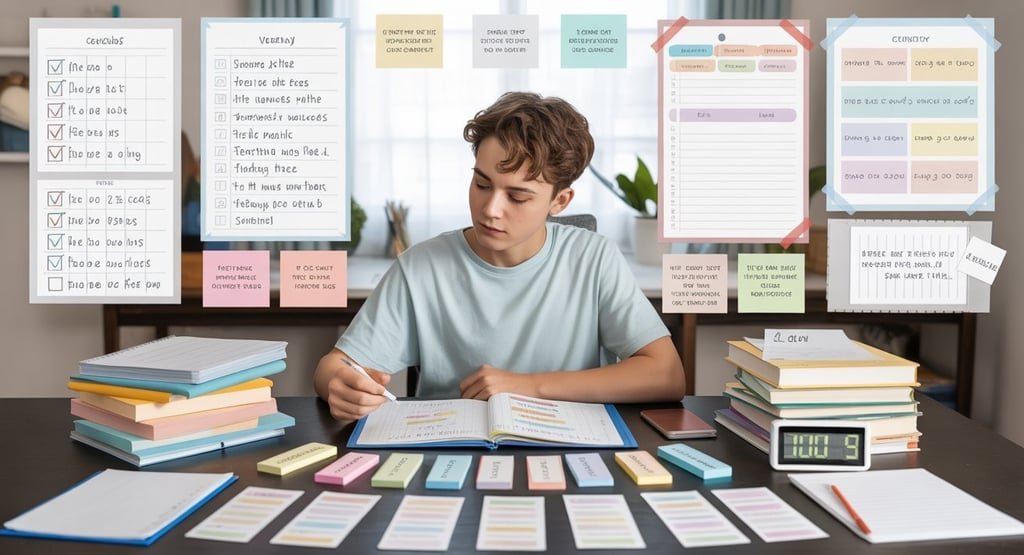
Why Executive Functioning is the Secret to GCSE Success
For many bright students, the challenge isn’t intelligence it’s executive functioning. This set of mental skills is what makes revision consistent and enables a student to apply knowledge effectively under exam pressure. Because GCSE, IGCSE and IB exams are tests of application, “knowing the topic” isn’t enough; students must execute their knowledge exactly how examiners reward it.
Our Approach: Reliable Systems + Exam Application
Our effective support focuses on two critical outcomes: (1) building a revision system that makes learning stick, and (2) mastering exam technique so that hard work actually converts into high marks.
The 8 Core Executive Functioning Skills We Build
- Time Management (Revision & Exam Pacing)
Using timed blocks and “minutes-per-mark” awareness to ensure students never run out of time during the actual exam. - Organisation (Materials & Routines)
Creating frictionless systems for notes and past papers so the student can start revising immediately without getting overwhelmed. - Task Initiation (Beating Procrastination)
Breaking daunting revision into “micro-starts” (e.g., “just do question one”) to overcome the barrier of getting started. - Sustained Attention (Building Stamina)
Utilizing short, high-intensity revision blocks with planned breaks, focusing on active testing rather than passive reading. - Working Memory Support (Multi-Step Accuracy)
Providing checklists and structured methods to reduce careless errors in complex Maths, Science, or English steps. - Planning and Prioritising (High-Impact Study)
Moving away from vague goals like “revise Science” and focusing on active recall and spaced repetition for the topics that matter most. - Self-Monitoring (The Error Log)
Teaching students to review their own answers against mark schemes, turning repeated mistakes into predictable improvements. - Emotional Regulation (Managing Exam Stress)
Coaching calm responses to “stuck” moments, preventing panic when faced with unfamiliar application-style questions.
What “Effective Revision” Actually Looks Like?
For IGCSE and GCSE success, revision must be active. We move students away from highlighting and re-reading toward:
- Active Recall: Testing from memory to strengthen neural paths.
- Spaced Repetition: Revisiting difficult topics at increasing intervals.
- Targeted Practice: Using past papers specifically to build exam stamina.
Why “Application” is the Grade-Maker?
Higher grades are won by students who know how to interpret command words accurately and structure their answers so examiners can easily award marks. Success is a skill that can be coached.
Research & evidence: executive functioning, ADHD and academic performance
A growing body of research links executive-function deficits in ADHD to poorer academic outcomes, especially where tasks demand sustained attention, planning, and complex application of knowledge. For a comprehensive review, see: https://pubmed.ncbi.nlm.nih.gov/24142854/ (Executive Functions and ADHD in Children: A Meta-Analysis)
Common ADHD traits that affect GCSE IGCSE and IB study
Inattention
Difficulty sustaining focus on routine or lengthy tasks (e.g., extended revision sessions) leads to uneven coverage of the syllabus.
Impulsivity
Rushed answers and skipping steps on multi‑part questions can lose method marks even when the student understands the topic.
Hyperactivity / restlessness
Difficulty sitting through timed practice papers reduces exam stamina and increases careless errors.
Poor working memory
Trouble holding multiple steps or rules in mind during problem solving (critical in Maths, Chemistry calculations, and multi‑step reasoning).
Difficulty with organisation & time management
Missed revision sessions, fragmented notes, and poor prioritisation reduce the efficiency of study time.
Emotional dysregulation
Frustration and anxiety during difficult practice can cause shutdowns that interrupt learning and reduce transfer to exam performance.
How executive‑function coaching helps — benefits applied to studying?
Executive‑function coaching translates clinical strategies into practical study systems. Below are the key benefits your students gain when coaching is applied with GCSE/IGCSE goals in mind.
- Structured routines that increase consistency
Coaching builds predictable, low‑friction workflows (what to study, when, and how long) so revision becomes habitual rather than random. - Task decomposition to overcome initiation barriers
Large tasks are broken to micro‑starts, so students reliably begin and complete practice activities. - Active memory supports and externalisation
Use of checklists, worked examples, and error logs lightens working‑memory load and improves accuracy on multi‑step problems. - Exam‑specific application practice
Coaching emphasises past‑paper techniques: command‑word interpretation, answer structuring, and method‑mark capture. - Metacognitive strategies and self‑monitoring
Students learn to spot patterns in errors and self‑correct, accelerating progress through targeted practice. - Emotional regulation and frustration tolerance
Simple coping scripts and break strategies reduce panic during challenging questions, enabling application under pressure.
FIFA approach: Focus, Introduce, Frame, Apply — a practical coaching cycle
We use a simple, repeatable FIFA cycle — Focus, Introduce, Frame, Apply — to turn coaching into classroom‑and‑exam ready skills.
Focus
Start each session with one clear learning goal (e.g., “use the quadratic formula accurately in 3-step problems”). Limiting scope reduces overwhelm and improves task initiation for ADHD students.
Introduce
Introduce one concrete technique or strategy (e.g., a checklist for multi‑step algebra). Keep instructions short, explicit and scaffolded so working memory is supported.
Frame
Frame the strategy with an exam‑relevant template: how the technique converts into examiner‑recognised steps (what to write, where to show working, how marks are awarded).
Apply
Practice under conditions that replicate the exam (timed, past‑paper questions) with immediate feedback and an error log to close the loop. Repetition in short, focused bursts builds stamina and transfer.
How our multidisciplinary team combines SEN tutors, coaches and learning designers?
Our outcomes improve because we blend SEN specialist tutoring and executive‑function coaching with professional learning designers. Each role contributes a distinct but complementary skill set.
SEN Specialists tutors — subject mastery with ADHD‑aware pedagogy
Tutors provide curriculum expertise (GCSE/IGCSE content knowledge) and adapt explanations to the student’s learning profile. They spot content gaps, model worked solutions, and rehearse exam‑specific application.
Executive‑function coaches — systems, routines and metacognition
Coaches focus on the “how” of learning: building routines, task initiation strategies, error logs, pacing plans and emotional regulation techniques. They ensure the student can use the tutor’s content reliably under pressure.
Learning designers — bespoke study systems that scale
Learning designers translate the tutor+coach work into durable resources: structured lesson sequences, short mastery checks, templates for answer structure, spaced‑review schedules, and digital toolkits (timers, checklists, flashcard decks). This makes successful practice repeatable and easier for parents or schools to maintain between sessions.
How the team works together in practice?
- The tutor diagnoses a content weakness via a past paper.
- The coach converts the diagnosis into a micro‑task and pacing plan (micro‑starts + minutes‑per‑mark).
- The learning designer builds a 20‑minute practice module and an error‑log template for repeated use.
- The student practices under exam conditions; the coach gives metacognitive prompts and the tutor reviews answer structure.
Combined benefits — why the team approach outperforms isolated tutoring
When the three roles are aligned, students gain: consistent practice habits, content mastery that’s demonstrably transferable to exams, clearer pacing and reduced careless errors, and resources that sustain progress between sessions.
Case studies (anonymised)
Case study 1 — “Sam”, 15, GCSE Combined Science & Maths
Background: Bright student with variable homework completion and frequent careless errors in maths multi‑step questions. Baseline: mock exam scores averaged 54% in Maths, with frequent lost method marks.
Intervention:
- Six 1‑hour EF coaching sessions over eight weeks combining: timed past‑paper practice (20‑minute blocks), a written error log, a checklist for multi‑step problems, and “minutes‑per‑mark” pacing practice.
Outcome:
- Post‑intervention mock: Maths increased to 68% with a visible reduction in method‑mark losses. Student reported greater confidence starting papers and fewer unfinished questions. Teacher feedback: improved homework completion and clearer working.
Case study 2 — “Aisha”, 16, IGCSE English & History
Background: High verbal ability but patchy exam technique; tended to lose marks for poor structuring and not directly addressing command words. Baseline: essay rubric average 60%.
Intervention:
- Four targeted sessions on command‑word decoding, paragraph structure templates, and timed plan‑and‑write drills using past papers.
Outcome:
- Within six weeks, rubric scores rose to an average of 75% in practice essays. In‑exam application improved: answers matched mark‑scheme expectations and pacing allowed completion of all required responses.
Contact
Email: info@senspecialists.org
Call: +44 742 1201 281