




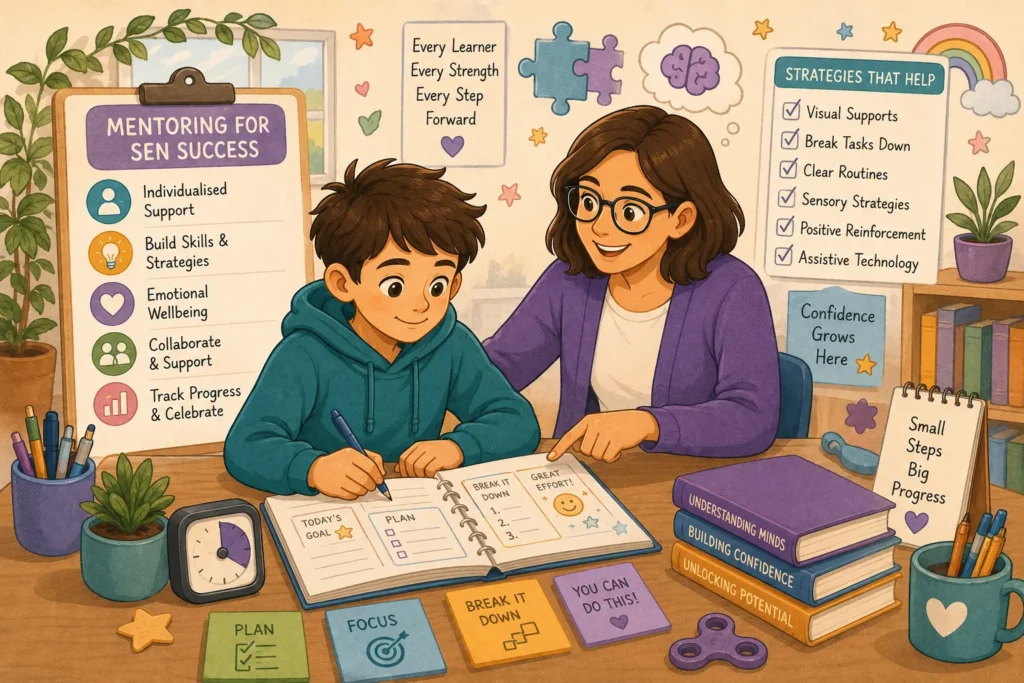
What is an education mentor for SEN students? An education mentor for SEN students combines academic coaching with specialist strategies for learning differences (e.g., dyslexia, ADHD, autism spectrum conditions, cognitive or communication needs). Their role goes beyond subject help to include scaffolding, executive function support, sensory-aware strategies and strong liaison with teachers, SENCOs and parents.
Key Responsibilities Education Mentor for SEN Students (tailored for SEN)
Individualised learning plans
Co-design SMART, achievable targets aligned to EHCPs (where relevant) and teacher objectives.
Executive function & organisation support
Teach planning, task initiation, time management, breaking tasks into steps and use of visual planners or checklists.
Differentiated instruction & scaffolding
Provide simplified explanations, worked examples, multisensory approaches and chunked instructions.
Social-communication and pastoral support
Coach social skills, manage anxiety, support transitions and model appropriate classroom interactions.
Sensory-aware adjustments
Recommend and use sensory strategies (quiet spaces, fidget tools, scheduled movement breaks) that help concentration and regulation.
Behavioural strategies and positive reinforcement
Use structured routines, clear expectations, token systems or behaviour plans consistent with school policy.
Liaison with SENCO, teachers and parents
Share progress, adapt in-class strategies, and ensure consistency across settings. Help translate specialist recommendations into classroom practice.
Monitoring and adaptive feedback
Use short, frequent formative checks and visual progress trackers; celebrate small wins and recalibrate targets.
Advocacy and transition planning
Support move between key stages, to post-16 study, or between schools; ensure reasonable adjustments are in place for exams.
Emotional regulation & wellbeing coaching
Teach simple coping strategies for overwhelm, use grounding techniques, and provide predictable mentoring routines.
Common traits and characteristics of SEN students (brief, non-exhaustive)
Dyslexia / literacy-related needs
Strengths: verbal reasoning, problem-solving; challenges: reading speed, spelling, written expression, decoding exam questions.
ADHD / attention differences
Strengths: creativity, energy, divergent thinking; challenges: sustained attention, task initiation, impulse control, organisation.
Autism Spectrum Condition (ASC)
Strengths: detail-focus, pattern recognition, honesty; challenges: social reciprocity, sensory sensitivities, flexible thinking.
Specific Learning Difficulties (e.g., dyscalculia)
Strengths: visual reasoning in some cases; challenges: number sense, working memory for calculations, sequencing steps.
Communication & interaction needs (e.g., speech/language difficulties)
Challenges: understanding multi-step instructions, expressive language for explanation or essay writing.
Social, emotional and mental health needs (SEMH)
Challenges: anxiety, low self-esteem, school avoidance, behaviour that can mask learning difficulties. Note: SEN profiles are diverse; many learners have overlapping needs (co-occurrence). Mentoring should be personalised and avoid labels that limit expectations.
Traits of an effective SEN education mentor
- Patience and calm consistency
- Good knowledge of common SEN strategies and reasonable adjustments
- Strong listening and rapport-building skills
- Ability to simplify language and scaffold tasks
- Flexible thinking and creative problem-solving
- Knowledge of safeguarding and confidentiality
- Collaborative approach with teachers, SENCO and parents
- Training in behaviour management, trauma-informed practice, and neurodiversity-aware methods
Strong record-keeping and progress-monitoring skills
Why SEN students need specialised mentoring — 10 reasons?
Personalised support addresses complex, overlapping barriers
SEN learners often have unique combinations of needs which classroom pacing cannot always meet.
Support for executive function and organisation
Many SEN students struggle with planning, working memory and task initiation — mentoring teaches practical strategies.
Improve access to curriculum through differentiation
Mentors translate curriculum tasks into accessible steps without lowering expectations.
Reduce anxiety and sensory overload with tailored strategies
Predictable routines, sensory adjustments and coping techniques make learning sustainable.
Teach compensatory strategies and study techniques
E.g., text-to-speech, mind-maps, chunking, visual supports and assistive technology.
Smooth transitions and exam access arrangements
Mentors help secure and prepare for reasonable adjustments, and coach students through changes in setting or level.
Provide consistent pastoral support and advocacy
Mentors act as a trusted adult who coordinates between home and school and voices the student’s needs.
Build self-awareness and self-advocacy
Help students understand their profile, strengths and strategies so they can request support.
Prevent exclusion and disengagement
Early, personalised intervention reduces behaviour escalation and school avoidance.
Improve long-term outcomes beyond exams
Mentoring promotes independence, employability skills and confidence for adulthood.Personalised support addresses complex, overlapping barriers
SEN learners often have unique combinations of needs which classroom pacing cannot always meet.
Support for executive function and organisation
Many SEN students struggle with planning, working memory and task initiation — mentoring teaches practical strategies.
Improve access to curriculum through differentiation
Mentors translate curriculum tasks into accessible steps without lowering expectations.
Reduce anxiety and sensory overload with tailored strategies
Predictable routines, sensory adjustments and coping techniques make learning sustainable.
Teach compensatory strategies and study techniques
E.g., text-to-speech, mind-maps, chunking, visual supports and assistive technology.
Smooth transitions and exam access arrangements
Mentors help secure and prepare for reasonable adjustments, and coach students through changes in setting or level.
Provide consistent pastoral support and advocacy
Mentors act as a trusted adult who coordinates between home and school and voices the student’s needs.
Build self-awareness and self-advocacy
Help students understand their profile, strengths and strategies so they can request support.
Prevent exclusion and disengagement
Early, personalised intervention reduces behaviour escalation and school avoidance.
Improve long-term outcomes beyond exams
Mentoring promotes independence, employability skills and confidence for adulthood.
SEN-specific mentoring strategies and examples
- Use multi-sensory instruction: combine visual, auditory and kinaesthetic methods for new concepts.
- Chunk tasks and use checklists: break assignments into 3–6 small steps with clear success criteria.
- Visual schedules and timers: help with transitions and focus (use 5–10 minute timers for work blocks).
- Scaffold writing: provide sentence starters, paragraph frames, or voice-to-text options.
- Provide worked examples and modelling: show step-by-step solutions before independent practice.
- Use assistive technology: text-to-speech, speech-to-text, calculation apps, and organisational apps (digital planners).
- Frequent, low-stakes retrieval practice: short quizzes or flashcards to build automaticity without pressure.
- Sensory regulation toolkit: planned movement breaks, quiet zones, and personalised seating options.
- Social stories and role-play: for social communication and expected behaviour in new settings.
- Predictable session structure: start with a quick warm-up, set goals, teach/practice one strategy, review and record progress.
Measuring impact for SEN mentoring
- Use small, frequent measures: task completion rates, short diagnostic checks, behaviour logs, and confidence/self-regulation scales.
- Track longer-term outcomes: attendance, engagement, reading age progress, attainment on targeted objectives, and successful transitions.
- Collect qualitative feedback from student, parent and teacher to capture wellbeing and functional gains.
- Share progress in concise reports aligned to EHCP outcomes (where applicable).
Safeguarding, training and governance
- Ensure mentors have up-to-date DBS checks and safeguarding training.
- Provide specific training on SEN profiles, assistive tech, positive behaviour supports, and trauma-informed practice.
- Keep clear records of sessions, outcomes and communications with parents/teachers.
- Set boundaries and confidentiality rules while ensuring necessary information is shared with SENCO and class teacher.
Quick wins for schools implementing SEN mentoring
- Start with a short diagnostic to identify 2–3 priority targets per student.
- Create a 6-week mentoring plan with weekly 20–30 minute sessions and a simple progress tracker.
- Equip mentors with a sensory toolkit and a checklist of assistive tech options.
- Run brief training (1–2 hours) for mentors on structured literacy approaches, chunking and executive function strategies.
- Introduce a one-page “student profile” (strengths, needs, successful strategies) to share with teachers and parents.
Conclusion SEN students benefit most from mentoring that is specialist, structured and collaborative. An education mentor for SEN learners plays a vital role in translating recommendations into classroom practice, teaching compensatory strategies, supporting wellbeing and enabling access to the curriculum. When mentors are well-trained, data-informed and connected to the school’s SEN framework, they deliver measurable gains in engagement, attainment and long-term independence.
Frequently Asked Questions
Q: How often should SEN mentoring sessions run?
A: Weekly 20–30 minute sessions are a good starting point; increase frequency around transition points or exam periods.
Q: Can peer mentoring help SEN students?
A: Peer mentoring can help with social skills and confidence, but should be carefully supervised and matched; peer mentors need training in boundaries and SEN-awareness.
Q: Do mentors need specialist qualifications?
A: Formal qualifications help but aren’t always required. Training in SEN strategies, safeguarding, and behaviour management is essential; close supervision by the SENCO is recommended.