




Professional SEND Advocacy: Supporting Families in the UK and Globally
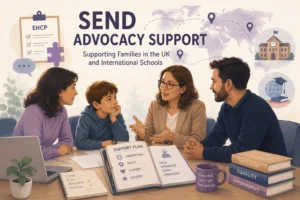
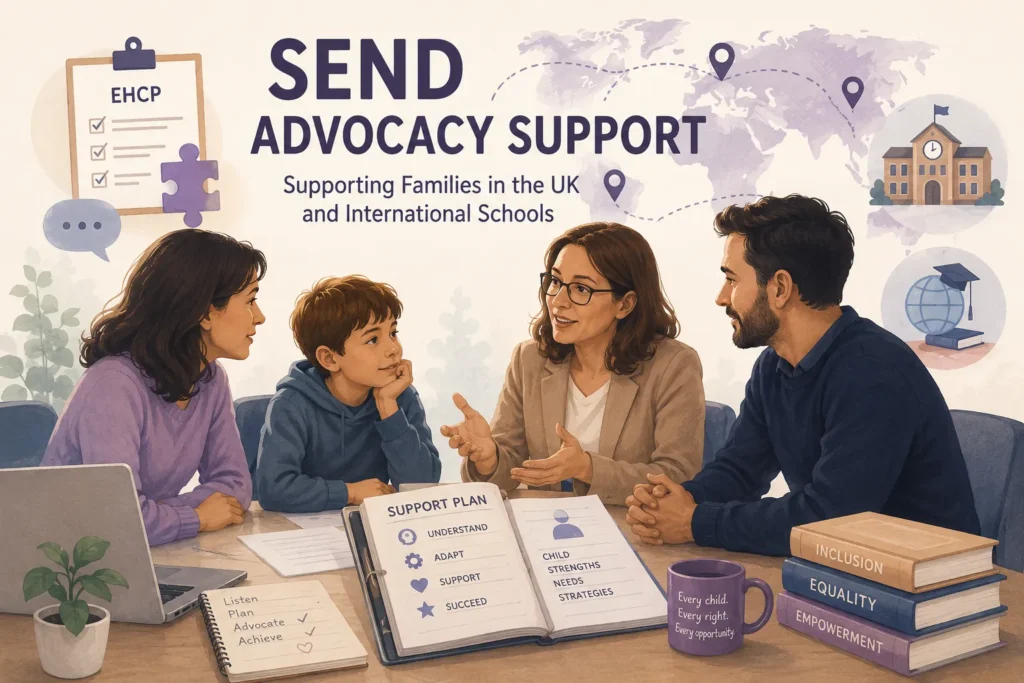
Navigating the landscape of Special Educational Needs and Disabilities (SEND) is a challenge that transcends borders. Whether you are navigating the statutory framework of a UK Local Authority or seeking appropriate provision within the diverse curricula of International Schools, professional advocacy is the key to securing your child’s right to an education.
- At SEN Specialists, we provide expert advocacy and learning design support for families engaging with:
- UK State and Independent Schools: Navigating EHCPs, ILPs, and the SEND Code of Practice.
International Schools: Supporting families in British, American, and IB (International Baccalaureate) schools across Europe, the Middle East, Asia, and beyond.
Global Advocacy: Navigating UK and International School Systems
The needs of a neurodivergent child remain the same regardless of their geography, but the systems designed to support them vary significantly. Our advocates and Learning Design Specialists are experts at translating a child’s needs into the specific terminology required by different educational systems.
Support for Families in UK Schools:
In the UK, the SEND system is governed by strict statutory timelines and legal definitions. We help parents manage mainstream and specialist state schools for EHCP assessments and Annual Reviews, independent schools to ensure “reasonable adjustments” are implemented, and provide tribunal support to assist independent legal teams.
Support for Families in International Schools:
International families often face unique challenges, such as a lack of statutory protection or inconsistent SEN provision between different schools. We support families in British International Schools to align with UK best practices, IB and American Curriculum Schools to adapt IEPs, and offer Transition Advocacy to ensure continuity of care during moves between the UK and international settings.
The Role of Learning Design Specialists in Advocacy
Traditional educational advocacy often focuses solely on legal terminology. At SEN Specialists, we elevate our advocacy by integrating Learning Design Specialists into the process.
A Learning Design Specialist looks beyond the diagnosis to understand how your child interacts with information, environments, and tasks. In an advocacy context, they help us state exactly what type of environment, teaching format, and adaptation your child needs to access the curriculum.
They challenge generic support plans by designing highly specific, measurable, and functional educational interventions, and create tangible learner profiles that serve as clear evidence of the adjustments required for your child to learn successfully.
Case Studies: Advocacy in Action
The following case studies demonstrate how we apply our combined approach of professional advocacy and learning design across both UK and international contexts.
Case Study 1: Securing UK Specialist Provision for a High-Potential Learner
- The Context: A UK-based mainstream primary school.
- The Challenge: Leo (aged 9) is academically bright but suffers from extreme school-induced anxiety and sensory overload. The Local Authority rejected an EHCP assessment, claiming his high grades meant he did not require specialist funding.
- The Intervention: Our SEND advocate and Learning Design Specialist produced a Functional Learning Profile. We proved that Leo’s academic success was masking a total cognitive collapse by midday. We represented the parents at a mediation meeting, using design-led evidence to show that his mental health was at risk.
- The Outcome: The Local Authority reversed its decision. Leo was granted an EHCP that funded 1:1 emotional support and a bespoke sensory timetable.
Case Study 2: Advocating within an International School (Middle East)
- The Context: A prestigious British International School in Dubai.
- The Challenge: Amelie (aged 13), diagnosed with ADHD and Dyslexia, was struggling with the heavy text-based demands of her curriculum. The school’s learning support consisted only of extra exam time, which did not address her daily barriers.
- The Intervention: Working with the family, our Learning Design Specialist redesigned Amelie’s subject templates and provided a Digital Learning Toolkit. Our advocate joined virtual meetings with the school’s Head of Inclusion to demonstrate how these modifications were essential to access the curriculum.
- The Outcome: The school adopted the Learning Design Specialist’s templates as part of Amelie’s formal support plan. Her engagement levels surged, and she began meeting her predicted grades.
Case Study 3: Managing the “Trans-Global” SEND Transition
- The Context: A family moving from a UK State School to an International School in Singapore.
- The Challenge: Toby (aged 11) has an EHCP in the UK for Developmental Language Disorder. His parents were concerned that moving to an international setting would mean losing his speech and language therapy (SLT) entitlements.
- The Intervention: We acted as the bridge during the transition. Our advocate reviewed the Singaporean school’s inclusion policy while our Learning Design Specialist translated Toby’s UK EHCP into a Global Learner Passport detailing how Toby’s AAC device needed to be integrated.
- The Outcome: The international school accepted the Global Learner Passport as the foundation of Toby’s new IEP. By the time they landed in Singapore, the school had already trained his teachers on his communication device, ensuring no lapse in progress.
Frequently Asked Questions
Q: Can you represent us in meetings with schools outside of the UK?
A: Yes. We regularly support families in international schools via virtual platforms. We are experienced in collaborating with inclusion teams in British International, IB, and American schools worldwide.
Q: How do you help with UK SEND Tribunals?
A: While we are not solicitors, we provide the vital educational documentation and expert Learning Design analysis that legal teams use to build cases. We help clarify what a child needs, making the legal argument for that provision much stronger.
Q: Do international schools have to follow my child’s UK EHCP?
A: International schools are not legally bound by UK EHCPs, but most high-quality international schools will respect the evidence within them. We help you translate your EHCP into a format that international schools can easily adopt and implement.
Contact SEN Specialists
Whether you are navigating the UK state system or looking for inclusion support in an international setting, our advocates and Learning Design Specialists are here to help.
Contact SEN Specialists today to secure the professional advocacy your child deserves, regardless of where they are in the world.