



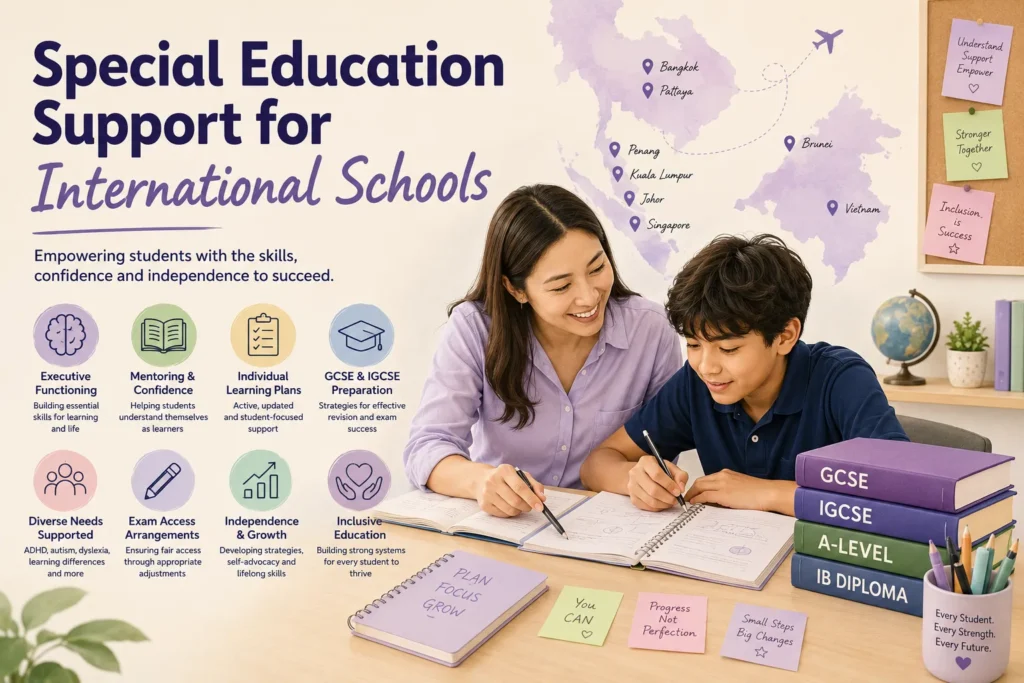
A Special Education Support for International Schools in Singapore, Malaysia, Thailand, Brunei and Vietnam
International schools across Southeast Asia have grown rapidly over the past two decades, attracting families seeking high-quality international curricula, including British, American and International Baccalaureate programmes.
Cities such as Singapore, Kuala Lumpur, Johor, Selangor, Penang, Bangkok and Pattaya have become important centres for international education, welcoming students from diverse cultural, linguistic and educational backgrounds.
With this diversity comes an increasing need for effective Special Education (SEN) provision that supports students with autism, ADHD, dyslexia, learning differences, executive functioning challenges and other additional educational needs.
However, supporting SEN students requires more than simply placing an additional adult in the classroom or providing subject-based academic support.
True inclusion requires specialist knowledge, personalised learning design, mentoring, effective intervention strategies and a clear understanding of how individual students learn.
Having lived in Singapore for eight years, worked within SEN schools in the UK, delivered Special Education workshops for British international schools and provided SEN consultancy support for international and private schools in Malaysia, I have seen first-hand both the strengths of international education and the challenges schools face when developing effective SEN systems.
Across Southeast Asia, including Malaysia, Thailand, Singapore, Brunei and Vietnam, many schools genuinely want to support SEN students. However, the systems, training and approaches used are not always sufficient to meet the needs of increasingly diverse learners.
The key question for schools should not simply be:
“How do we provide support?”
It should be:
“How do we help students develop the skills, confidence and independence to succeed?”
The Common International School Model: Additional Learning Support
Across many international schools, a common approach to SEN support involves families paying for additional learning support.
Often, this support is provided through a teaching assistant or learning support assistant who works alongside a student in the classroom or provides one-to-one guidance.
A skilled teaching assistant can be extremely valuable. They can help students access lessons, build confidence and provide encouragement.
However, special education support should involve more than having an adult sit beside a student throughout the school day.
The purpose of support should not only be to help students complete tasks. It should be to help them develop the skills required to eventually manage those tasks independently.
Effective SEN provision needs to consider:
- How the student processes information
- How they manage attention and focus
- How they organise their work
- How they approach problem-solving
- How they communicate their understanding
- What strategies allow them to demonstrate their ability
Without specialist guidance, support can sometimes become supervision rather than intervention.
Why SEN Students Need More Than Classroom Assistance
Many students with additional needs are not struggling because they lack ability. The barrier is often the way learning is structured or the demands placed upon them.
For example, a student with ADHD may understand complex academic concepts but struggle with:
- Starting assignments
- Managing deadlines
- Organising materials
- Prioritising tasks
- Revising effectively
- Completing independent work
An autistic student may have excellent academic ability but require support with:
- Processing information
- Understanding expectations
- Managing changes in routine
- Interpreting instructions
- Reducing cognitive overload
A teaching assistant who has not received specialist training in special education may not know how to develop these underlying skills.
The objective should not be to create dependence on adult prompting. The objective should be to build independence.
The Role of Mentoring in Special Education Support
One of the most overlooked areas of SEN provision is mentoring.
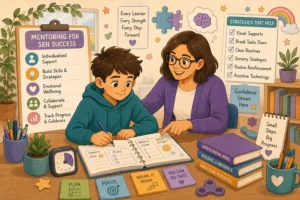
While tutoring focuses primarily on academic knowledge and teaching support, mentoring focuses on helping students understand themselves as learners and develop the personal skills required to succeed.
For many neurodiverse students, especially those with ADHD, autism or executive functioning difficulties, academic challenges are often connected to confidence, organisation, motivation and self-awareness.
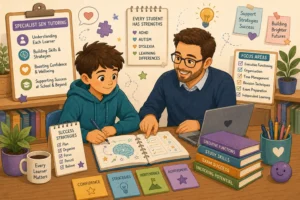
A specialist mentor can support students with:
- Understanding their own learning profile
- Developing self-advocacy skills
- Building confidence
- Setting realistic goals
- Managing academic pressure
- Developing independence
- Reflecting on what strategies work best for them
Mentoring is particularly valuable for students who appear capable but are not achieving their potential.
This includes:
- Twice-exceptional (2e) gifted and talented students
- High-achieving students with ADHD or autism
- Students who are underperforming despite strong ability
- Students transitioning between educational stages
Many students know they are capable but become frustrated because they cannot consistently translate ability into achievement.
Mentoring helps bridge that gap.
Executive Functioning: Teaching Students How to Learn
One of the most important areas of development for many SEN students is executive functioning. Executive functioning refers to the skills that help students manage learning, including:
- Planning
- Organisation
- Time management
- Task initiation
- Emotional regulation
- Working memory
- Following through with tasks
Many students who appear unmotivated or disorganised are actually experiencing executive functioning challenges.
They may know what they need to do but struggle with how to begin.
Effective SEN mentoring and intervention should teach students practical strategies to:
- Break large tasks into smaller steps
- Create realistic study schedules
- Overcome procrastination
- Prioritise workload
- Manage coursework deadlines
- Develop independent learning habits
These skills are essential for success in GCSE, IGCSE, A-Level and IB programmes.
GCSE and IGCSE Exam Preparation: Beyond Subject Knowledge
For many SEN students, examination success depends on more than knowing the subject content. Students also need to understand how to apply their knowledge effectively under examination conditions.
Specialist SEN intervention should include:
- Revision planning
- Active recall strategies
- Retrieval practice
- Exam question analysis
- Understanding mark schemes
- Structuring written answers
- Developing exam confidence
- Managing exam anxiety
Students need to learn not only what to revise, but how to revise effectively.
Individual Learning Plans Must Be Active and Updated
Another area where international schools can strengthen special education provision is through the effective use of Individual Learning Plans (ILPs), Individual Education Plans (IEPs) or equivalent support documents.
In my experience working with international schools, one challenge is that these plans are sometimes created but not reviewed regularly enough.
An effective learning plan should be a working document that changes as the student develops.
It should include:
- Current strengths
- Areas of difficulty
- Effective strategies
- Intervention goals
- Progress monitoring
- Updated recommendations
Students develop over time, and their support plans should evolve with them.
Examination Access Arrangements: Providing Appropriate Support
For students studying GCSE, IGCSE, A-Level or IB programmes, examination access arrangements can play a vital role.
However, many schools focus primarily on obtaining extra time.
Extra time may be appropriate for some students, but effective access arrangements should be based on the individual’s specific needs and supported by appropriate evidence.
Students may require adjustments such as:
- Rest breaks
- Separate examination environments
- Use of a computer
- A reader
- A scribe
- Assistive technology
- Other reasonable adjustments
- The aim should not be to obtain the minimum adjustment possible.
- The aim should be to ensure students have fair access to demonstrate their knowledge, skills and understanding.
- Access arrangements do not provide an advantage. They remove barriers.
Building Stronger Special Education Systems Across Southeast Asia
International schools in Singapore, Kuala Lumpur, Johor, Selangor, Penang, Bangkok, Pattaya, Brunei and Vietnam have a unique opportunity to become leaders in inclusive education.
The future of SEN support is not simply adding more adults into classrooms.
It is developing systems where:
- Teachers understand neurodiversity
- Support staff receive specialist training
- Students receive mentoring alongside academic support
- Learning plans are regularly reviewed
- Examination arrangements are carefully considered
- Students develop independence and confidence
Every SEN student deserves more than someone sitting beside them.
They deserve specialist support that helps them understand themselves as learners, develop effective strategies and achieve their potential.
About the Author
James is an SEN Consultant specialising in GCSE and IGCSE interventions, Executive Functioning skills, mentoring and student-focused learning design.
James has extensive experience within the Special Education sector, having worked in SEN schools in the UK supporting students with a wide range of learning needs. He has delivered SEN workshops for SENCOs, teachers, teaching assistants and tutors, helping education professionals develop more effective approaches to supporting neurodiverse learners.
Having lived in Singapore for eight years and worked across Southeast Asia, James has developed a strong understanding of the challenges faced by international schools, families and students navigating SEN provision across different educational systems.
He has delivered workshops for British international schools and provided SEN consultancy support to international and private schools in Malaysia, while also working with families and educators across the wider Southeast Asian region.
James specialises in GCSE and IGCSE interventions, exam preparation strategies, Executive Functioning development and mentoring. His work supports students with ADHD, autism and other learning differences, as well as twice-exceptional gifted and talented students and students who may be underachieving despite having strong academic potential.
James holds a BA in Education: Special Educational Needs and Disability (SEND) and a PGCE in Education: Creative Teaching and Learning Design.
Through SENSpecialists.org, James works with students, families and schools to create personalised learning pathways that combine special education expertise, academic intervention, mentoring and effective learning design.
His approach focuses on helping students develop not only academic success, but also independence, confidence, self-awareness and the lifelong learning skills required for future education and beyond.
Website: www.senspecialists.org