





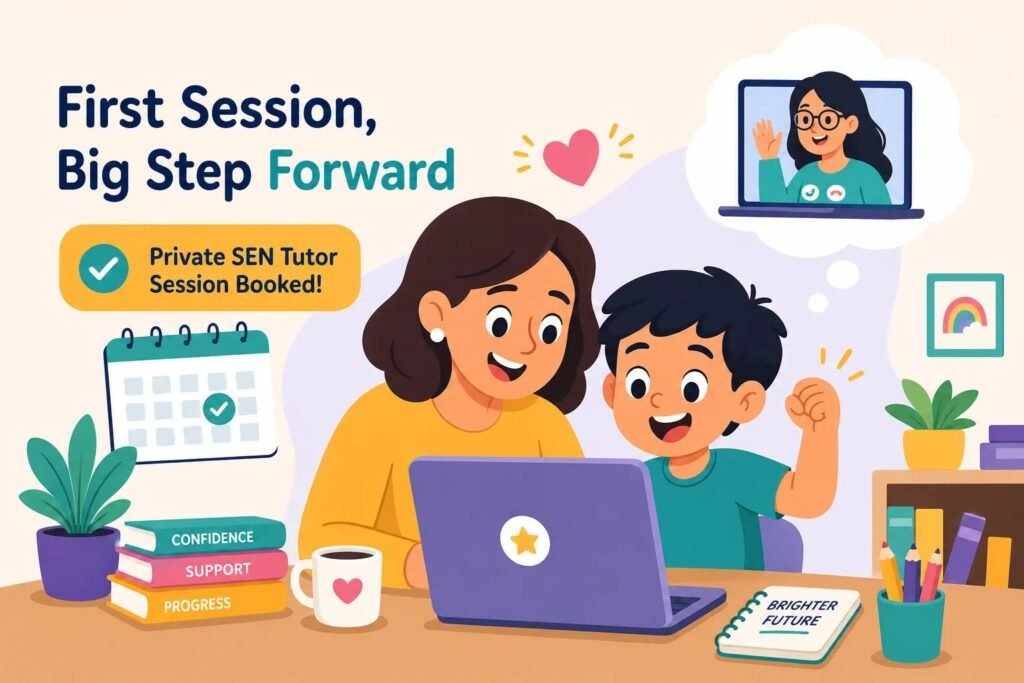
Booking an introductory session with a private SEN tutor does not usually commit you to ongoing tuition, though terms vary by provider, always check cancellation and commitment clauses in writing before you proceed. For many providers, the process unfolds across three stages: an initial consultation to discuss your child’s profile, a specialist matching stage, and then a first teaching session. Many parents report feeling uncertain about what to share, what to ask, and what a genuinely good match looks and feels like.
That uncertainty is understandable, and it is exactly what a well-structured intake process is designed to resolve. At SEN Specialists, our initial consultation is built around gathering the right information so that every first session is already tailored to the child, not starting from scratch. This guide walks you through each stage so you know what to expect, what to prepare, and what questions to ask before you commit to anything.
Key takeaways
- Two distinct meetings: A consultation call and a trial lesson are not the same thing. Knowing which you are booking prevents disappointment on the day.
- Prepare before you call: Sharing your child’s diagnosis, relevant documents, and what motivates them gives any tutor a far stronger starting point.
- Safeguarding is non-negotiable: Ask to see the relevant disclosure certificate, Enhanced DBS in England and Wales, PVG in Scotland, or AccessNI in Northern Ireland, and confirm it is current before any sessions begin. Ask whether the tutor is subscribed to the DBS Update Service where applicable.
- Specific answers over vague assurances: A tutor who describes concrete adaptations is more informative than one who simply claims to be an “SEN specialist.”
- Confirm terms in writing: Pricing, cancellation policies, and what happens if the match is unsuitable should all be confirmed before you book.
- Trust your child’s response: After the session, ask your child open questions. Their instinctive sense of safety and comfort is one of the most reliable indicators of fit.
What is the difference between a consultation call and a trial lesson?
A consultation call and a trial lesson are two entirely different meetings, and confusing them is one of the most common mistakes parents make at this stage. A consultation call, typically 15 to 30 minutes, is focused on understanding your child’s needs and assessing whether the provider is the right fit. A trial lesson is an actual teaching session, often 45 to 50 minutes, where tutor and learner work together for the first time on real content or initial assessment activities.
Some providers offer both in sequence; others offer only one. Before you book an introductory SEN session, confirm in writing which format you are being offered and what it will include. Arriving at a consultation expecting a lesson, or vice versa, creates confusion and wastes time that should be spent building rapport and gathering useful information.
For younger children, or those with limited attention spans or high fatigue, a shorter first session of 30 to 45 minutes with built-in breaks is often more appropriate than a standard 60-minute lesson. The session length should reflect your child’s profile, not a default format that suits the provider’s scheduling. A specialist tutor should be flexible on this point from the very outset, if they are not, that tells you something worth knowing.
How do you prepare your child’s information before the booking?
The more a tutor knows before that first meeting, the more productive the meeting will be. Plan to share your child’s diagnosis, or suspected needs if no formal diagnosis is yet in place, the subjects or skills causing the most difficulty, and any anxiety your child carries around learning or previous tutoring experiences. It also helps to describe what motivates your child and how they prefer to communicate, whether that is through conversation, visual prompts, or doing rather than talking.
There is no perfect script for describing a child’s needs, and you should not feel pressure to have one. A good tutor will ask the right questions to draw out what they need to know, and they should listen as much as they speak during the consultation. What matters is that you arrive with a clear sense of your child’s day-to-day experience rather than a polished summary.
Certain documents can give a tutor a genuine head start: Education, Health and Care Plans (EHCPs), educational psychologist reports, school SEN support plans, recent report cards, and any exam access arrangement letters. You do not need to share everything upfront, but having these to hand during the consultation means the tutor can plan a genuinely informed first session. At SEN Specialists, our consultation is structured to gather this information systematically, so nothing important falls through the gaps before teaching begins.
What qualifications and safeguarding checks should you confirm?
Safeguarding is not a box-ticking exercise. It is the foundation of any trustworthy tutoring arrangement. For a tutor working unsupervised with a child, ask to see the appropriate disclosure certificate. The relevant system differs across the UK: Enhanced DBS applies in England and Wales, PVG in Scotland, and AccessNI in Northern Ireland. Check the original certificate, note when it was issued, and ask whether the tutor is subscribed to the DBS Update Service, as a certificate has no universal expiry date and an older check may warrant renewal. It is worth noting that, as of January 2026, eligible self-employed tutors in England and Wales can now apply directly through a registered Umbrella Body, worth confirming when you request their certificate.
A clear safeguarding check is not a guarantee of suitability on its own. It should sit alongside references, agreed safeguarding procedures, and clarity on where and how sessions take place. For online tuition, ask which platform is used, how sessions are kept secure, and what the supervision arrangements are during lessons.
On qualifications, Qualified Teacher Status is useful but not essential. What matters more is evidence of training directly relevant to your child’s needs: autism-informed teaching, ADHD strategies, Level 5 or Level 7 SpLD qualifications for dyslexia, or executive function coaching. Ask any tutor to explain concretely how they adapt pace, task structure, instructions, and sensory demands for an individual learner. Vague claims of being an “SEN specialist” without supporting detail are a warning sign, not a reassurance.
What questions should you ask during the initial SEN consultation?
The consultation is your opportunity to assess whether this tutor will genuinely understand your child, not just their subject. Start with approach and adaptability. Ask how they break tasks into manageable steps, how they use visuals, movement, or the child’s interests, and how they build independence rather than creating reliance on the tutor. The most telling question you can ask is what they would do if your child became overwhelmed or refused to engage. A strong answer describes a practical, calm response; a weak one reassures you that “it rarely happens.”
For assessment and planning, ask how they will identify your child’s starting point and what the first few sessions would realistically involve. Ask whether they can align their approach with your child’s EHCP or school strategies. A tutor who describes a concrete, individualised plan is far more credible than one who promises to “work through the curriculum.” Questions about progress and reporting matter equally: how will they measure progress beyond test scores, how often will goals be reviewed, and what feedback will you receive after each session?
Do not overlook practical matters. Ask about cancellation and payment terms, professional indemnity or public liability insurance, and what happens if the tutor match turns out to be unsuitable. Notice not only what the tutor says, but how they say it. Are their answers specific and honest, or are they managing your expectations with reassuring generalities? Also watch whether they engage directly with your child during the call, asking about interests and experiences rather than treating the child as a passive subject of discussion.
How to book an introductory session with a private SEN tutor: what it looks and feels like
A well-run first session is calm, structured, and low-pressure. The tutor greets your child in an unhurried way, explains what will happen, and spends time on rapport before moving into any academic content. Activities are designed to reveal strengths as well as gaps, and instructions are given in small, clear chunks rather than delivered as a long block. Your child is offered choices and moments of autonomy where possible, and breaks are built in rather than offered as rewards for compliance.
The tutor should explain to your child, not just to you, what they are doing and why. A child who understands the purpose of an activity is far more likely to engage with it than one who is simply told what to do. Providers operating a collaborative model, such as SEN Specialists, use the expertise of learning designers and executive function specialists behind the scenes to inform even the first session, so the approach is already tailored rather than generic from the outset.
After the session, ask your child some open questions: Did you feel comfortable? Did they listen to you? Were explanations clear? Would you feel able to say when you were confused or needed a break? A child who is usually reluctant may still be quiet or cautious in a first session, and that is entirely normal. What matters is whether they felt safe, understood, and respected. Their instinctive response is one of the most reliable indicators of a genuine fit.
How does pricing and booking actually work for a first session?
A free introductory consultation is fairly common at specialist providers, with many offering 15 to 30 minutes at no charge. A full trial teaching session is a different matter, and costs vary considerably depending on the type of tutor and level of specialism.
| Tutor type | Typical hourly rate | Trial session cost |
|---|---|---|
| Online marketplace tutor | £25–£35 per hour (approx.; Superprof 2026) | Often free (first lesson) |
| Experienced qualified SEN specialist | £45–£60 per hour (approx.; Tutorful data) | Free consultation, then charged at standard rate |
According to Superprof, roughly 97% of their listed tutors advertise a free first lesson, though this may be shorter than a standard session and focused on suitability rather than substantive teaching. Some specialist providers offer a reduced rate for an initial block of sessions before moving to their standard fee. Confirm whether this applies and what the terms are before you commit. According to Tutorful, experienced and qualified SEN specialists typically charge around £45 to £60 per hour, while more highly specialised or agency-based provision commonly runs to £60 or more per hour.
Before you book a SEN tutor consultation, confirm in writing whether the “trial” means a short consultation or a full teaching session, including the session length, and check the cancellation deadline. Cancellation notice periods vary by provider, many commonly ask for 12 to 24 hours, and cancelling later may incur a full or partial charge, though you should always verify this with your specific provider. Block bookings may carry expiry dates, minimum commitments, or automatic renewal clauses.
A free introduction, a free trial lesson, a tutor replacement guarantee, and a cash refund are four entirely separate things. Do not assume that one implies another. Ask directly: if the first session does not feel right, what are your options? A reputable provider will answer that question clearly, without hesitation.
Making the first step feel manageable
The introductory process has a clear shape, and knowing that shape in advance makes it far less daunting. Prepare your child’s profile, gather relevant documents, confirm safeguarding checks, and go into the consultation with a focused list of questions about approach, adaptability, progress reporting, and practical terms. A good first session should feel calm, personalised, and honest about what comes next.
If you want a provider that handles the consultation and matching in a structured, specialist-led way, SEN Specialists offers exactly that kind of joined-up initial process. Every student is supported by a specialist tutor working alongside learning designers, executive function mentors, and progress reviewers, so the support your child receives is genuinely multidisciplinary from the first session onwards. Get in touch with our team to find out how we can help your child get started.
Ready to book an introductory session with a private SEN tutor? The right match is within reach. Going in prepared, clear on what to look for, what to ask, and what to confirm in writing, means far less second-guessing and a much stronger start for your child.
Frequently asked questions
What is included when I book an introductory session with a private SEN tutor?
This varies by provider. Some offer a free consultation call (typically 15 to 30 minutes) focused on understanding your child’s needs, while others begin with a paid SEN tutor trial lesson. Always confirm in writing what the session includes, how long it lasts, and what, if anything, it costs before you book.
How is a SEN tuition introductory consultation different from a trial lesson?
A SEN tuition introductory consultation is a structured conversation, usually between parent and tutor, designed to assess fit and gather information about your child’s needs. A trial lesson is an actual teaching session with your child present. The two serve different purposes, and some providers offer both in sequence.
What should I have ready before I book a SEN tutor consultation?
It helps to have your child’s diagnosis or suspected needs, any relevant documents (such as an EHCP or educational psychologist report), a description of what motivates your child, and a list of questions about the tutor’s approach, qualifications, and safeguarding checks.
Is a private SEN tutor booking usually flexible if the first session does not work out?
Policies differ. Ask directly what happens if the match feels unsuitable after the first session, whether that means a replacement, a refund, or neither. A reputable provider will answer this clearly before you commit.